
CNNMoney.com
Companies Economy International Corrections Pre-market trading After-hours trading Winners/losers/actives Bonds Currencies Commodities Money Magazine Retirement Mutual Funds Taxes Ask the Expert Money 101 Autos Loan Center Best Places to Live Calculators Mortgage Rates Personal tech Big Tech blog Techland blog Sectors and stocks Fortune 500 techs Tech Talk 100 best places to launch Ultimate resource guide Small biz makeovers FSB 100 Ask & Answer Fortune 500 Technology Investing Management Rankings Main Create portfolio Edit portfolio Create Alerts Edit Alerts

GM tests fuel cell cars in real world

The Chevrolet Equinox Fuel Cell will generate PR and feedback, but is this really the future of personal transportation?

Path to the future
GM is not aiming for a production version of the Equinox Fuel Cell. Instead, GM is turning its attention to what it calls the E-Flex platform, which would enable plug-in vehicles with a various systems for on-board back-up power generation.
Chevrolet Equinox Fuel Cell
Path to the future
A purely hydrogen-driven vehicle, like the Equinox Fuel cell, is one of two paths GM says it's pursuing toward a hydrogen-fueled production vehicle.

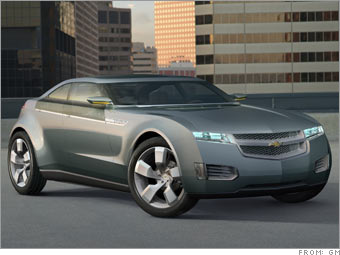
The other, called the E-flex platform, is the basis of the Chevrolet Volt concept car.

The Volt is an electrically-driven vehicle. Its wheels are turned by electric motors that draw power from a battery. The battery, in turn, is charged by plugging into an electrical socket. One overnight charge should be good for 40 miles of driving.

If the Volt runs low on power, its small gasoline engine would start up to recharge the battery on the fly.

But that gasoline engine could be a hydrogen fuel cell instead. That way, the Volt would be a full-time zero-emissions vehicle even when generating its own power.

Allowing the vehicle to charge from a wall outlet would mean greater range. The downside is that a system like this requires battery technology that doesn't yet exist. The batteries would have store and release enough energy to drive a vehicle at full speed without assistance from an engine or fuel cell.

The batteries would also have to stay cool and last the life of the vehicle. GM is working with two battery companies to research possible solutions, but there is no guarantee the problems will be solved any time soon.

Other car companies have expressed skepticism about GM's E-Flex plan. Ford, for instance, has a drivable plug-in fuel cell vehicle but has made it clear it has no notion of bringing such a vehicle to market in the foreseeable future.

Toyota has also said the battery technology required for viable plug-in vehicles will not be available soon.


Project Driveway

Fuel Cell

Power flow

Water

Safety

Future

Challenges
Robocar 2057: 8 visions of the future Car designers show off their ideas for the ultimate robot-controlled cars of the future in the Los Angeles Auto Show's 'Design Challenge' contest. (more)
50 years of Toyota in the U.S. On October 31, 1957, Toyota officially opened for business in the United States. The American auto business hasn't been the same since. (more)
Diesel Audi: Fast and fun but not for you The German carmaker isn't planning to sell its V8 diesel in the U.S. But it shows just how good one can be. (more)
© 2008 Cable News Network. A Time Warner Company. All Rights Reserved. Terms under which this service is provided to you. Privacy Policy
Copyright © 2008 BigCharts.com Inc. All rights reserved. Please see our Terms of Use.
MarketWatch, the MarketWatch logo, and BigCharts are registered trademarks of MarketWatch, Inc.
Intraday data delayed 15 minutes for Nasdaq, and 20 minutes for other exchanges. All Times are ET.
Intraday data provided by Interactive Data Real-Time Services and subject to the Terms of Use.
Historical, current end-of-day data, and splits data provided by Interactive Data Pricing and Reference Data.
Fundamental data provided by Hemscott.
SEC Filings data provided by Edgar Online Inc..
Earnings data provided by FactSet CallStreet, LLC.