

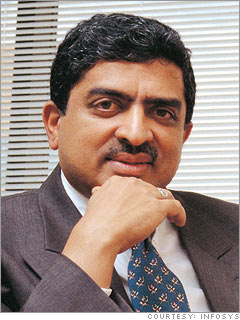


Co-Chairman of the Board of Directors, Infosys
Regardless of who is at fault, India has no choice but to plan for the effect global warming will have on its citizens. The predicted increase in water levels is going to be devastating for low-lying areas in the Sundarbans and other coastal regions. The already stretched supply of water is going to become an acute problem due to the depletion of Himalayan icecaps that feed India's rivers in its most populated areas. India's first priority should be to plan for conserving and providing potable water for the billion-plus population. And it has to figure out how to support the millions of people displaced by the rising waters, most of whom depend on the local forests and waters for their livelihood.Second, India cannot deny its citizens a decent standard of living; and yet we cannot blindly adopt the same traditional development models that are causing environmental degradation. If India and China were to achieve the Western standard of living using traditional development models, we will need more than one planet to live on. It is clear that we have to fashion a new kind of development model that is ecologically sustainable.
The government should create regulation to encourage responsible behavior, such as enforcing emissions standards for vehicles and better water management. It can impose fees and taxes on activities that are injurious to the environment - essentially putting a price on environmental degradation. It should design a carbon cap and trade mechanism suitable for the Indian context. This can be complemented by subsidies to those forms of corporate and individual behavior that are good for the environment. Finally, governments should invest in developing carbon-efficient technologies for use in India.
Developed countries today contribute 70 percent of global carbon emissions. Therefore, any meaningful reduction in carbon emissions requires the full participation of developed countries. They should undertake aggressive carbon reduction initiatives without delay as the impact of greenhouse gases is cumulative. In addition, they should invest in researching sustainable energy technologies and transferring these technologies to the developing world.
Besides governments, companies also have to become more innovative, efficient and more environment-friendly. They have to reduce their consumption of energy, water and non-renewable resources. At Infosys, for example, through our Ozone initiative, we set specific targets for annual reduction in consumption of resources such as water, paper and energy. We are using technology and introducing ways to reduce, reuse and recycle all types of waste, including e-waste. Through such initiatives, companies can adopt sustainable practices and encourage their employees to do the same.


