

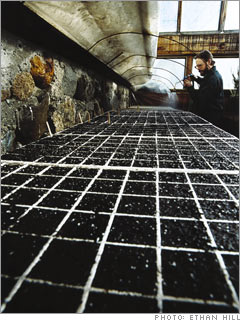


Of course, not all farmers are that fortunate. If one should overinvest in new equipment to satisfy Whole Foods' voracious demand and it then turns out that the product doesn't move well in the stores, well, a different kind of haircut awaits. To avoid that risk, some farmers, such as Dave Colson, will sell only 15 percent or so of their harvest to Whole Foods, and are content to remain small. Also, they can command better prices selling organic salad greens to local chefs and the rest of their crop directly to consumers who come to the farm or shop at local farmers' markets.
Phinney takes on all types. In many ways she's the perfect fit for the forager's job - she was an organic farmer before a tour of duty with the Massachusetts Department of Agriculture. On her days off she still works on a goat farm - Crystal Brook Farm in Sterling, Mass. - which keeps her in touch with the challenges that face New England's several hundred food artisans. She often helps business owners fill out the paperwork, coaching her prospective suppliers on how to meet Whole Foods' stringent quality standards, which largely revolve around definitions of "organic." The USDA's definition is tortuous (it can be found at usda.gov). Put simply, to be classified as organic, crops must be grown without toxic chemicals and raised with natural and sustainable farming techniques that do not degrade the ecosystem. The differences in standards between dairy, meat and crops are detailed and many - but the overall principle is the same: no toxic chemicals or fertilizer for plants, no antibiotics or chemically enhanced feed for livestock.
 These days just about everyone wants to be an entrepreneur. Here are eight people - women, immigrants, corporate refugees, minorities, even kids - who got in on the action. Here's what they have to say about it. (more) These days just about everyone wants to be an entrepreneur. Here are eight people - women, immigrants, corporate refugees, minorities, even kids - who got in on the action. Here's what they have to say about it. (more)  Are you thinking of starting a business? Got a question about financing, technology, taxes, team management, or any other topic related to launching or owning your own firm? The FSB editors are standing by to help. (more) Are you thinking of starting a business? Got a question about financing, technology, taxes, team management, or any other topic related to launching or owning your own firm? The FSB editors are standing by to help. (more) |


