

CNNMoney.com
Companies Economy International Corrections Pre-market Trading After-hours Trading Winners/Losers/Actives Bonds Currencies Commodities World Markets Money Magazine Real Estate Taxes Jobs Ask the Expert Money 101 Autos Mutual Funds The Help Desk Loan Center Best Places to Live Ask the Expert Ultimate Guide to Retirement Retirement Calculators Best Funds Best Places to Retire Fortune Brainstorm Tech Apple 2.0 Blog Big Tech Blog Sectors and Stocks Tech Talk Resource Guide Small Business Makeovers Questions & Answers Small Business Video 100 Best Places to Launch FSB 100 Fortune Small Business Fortune 500 Brainstorm Tech Investing Management C-Suite Rankings Main Create Portfolio Edit Portfolio Create Alerts Edit Alerts

8 big ideas to watch in '08

Sir Richard will help fund U.S. entrepreneurs, jetpacks will finally fly, and GPS devices will show the cheapest gas nearby - plus much more! Check out our Next Little Thing picks for 2008.

A greener charcoal
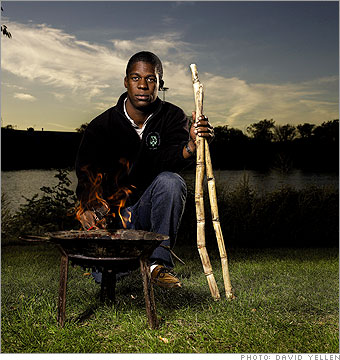
Jules Walter makes his charcoal from sugar cane waste. It burns cleaner than rival products.
A greener charcoal
Cooking fuel doesn't seem like much to ask for, but an estimated 2.4 billion people worldwide struggle to find it. Consider Haiti, where 700 tons of wood is burned annually, and smoke from thousands of charcoal fires has led to widespread respiratory infections. "Propane is not accessible, and electricity is not affordable," says Haitian native Jules Walter. "These people do not have any alternative."

That's why Walter has started a company called Bagazo to sell low-cost charcoal briquettes made from plant waste to his countrymen. Bagazo is Spanish for "bagasse," or sugar cane waste, but corn cobs and banana leaves can also be used in Walter's process.

The waste material is carbonized, mixed with a binder, pressed into briquettes, and allowed to dry. The result burns far cleaner and longer than wood.

It costs $3 to make a 44-pound bag of Bagazo briquettes, $2 cheaper than the production cost of regular charcoal. Walter will sell the bags for $5 each - just as soon as he graduates from MIT in 2008.

Bagazo is locking in partnerships with local sugar cane suppliers and encouraging them to buy shares in the company. Since electricity is pricey, his team is considering using solar technology to power the carbonization machines.

Walter thinks he's looking at a $125-million-a-year market in Haiti alone, but he is aiming for a more modest $3.1 million in annual revenue by 2012. If all goes well in Haiti, Bagazo will replicate the concept in other developing countries, such as Kenya and Tanzania. "We want to inspire entrepreneurs," Walter says. "It is possible to do good and make money. You need to believe in how your company can impact the world."
Virgin Money

Electric cars

Greener charcoal

Jetpacks

Wi-Fly

Weedy wine

Real estate in '08

Advanced GPS
Read the full stories behind our 8 picks for 2008. (more)
Behind the scenes at the Boston launch of Virgin Money, Richard Branson's new peer-to-peer lending service. (more)
Check out how our past Next Little Thing picks are holding up. (more)
© 2009 Cable News Network. A Time Warner Company. All Rights Reserved. Terms under which this service is provided to you. Privacy Policy
Copyright © 2009 BigCharts.com Inc. All rights reserved. Please see our Terms of Use.
MarketWatch, the MarketWatch logo, and BigCharts are registered trademarks of MarketWatch, Inc.
Intraday data provided by Interactive Data Real-Time Services and subject to the Terms of Use.
Intraday data is at least 20-minutes delayed. All times are ET.
Historical, current end-of-day data, and splits data provided by Interactive Data Pricing and Reference Data.
Fundamental data provided by Morningstar, Inc..
SEC Filings data provided by Edgar Online Inc..
Earnings data provided by FactSet CallStreet, LLC.