



Not every farmer gives up precious soil space to plants that aren't his crop. Still fewer bury cow horns beneath flower beds or treat vines with teas made from fermented Holstein manure. But Tunnell, 58, is not your average vintner. In early 2008 he will become one of the first in the U.S. to sell a wine that's certified as made in an entirely biodynamic vineyard. His 2006 vintage - 4,200 cases of three biodynamic varietals, chardonnay, gamay, and pinot noir - will go for $25 to $50 a bottle.
Biodynamics is a set of farming principles laid down by Austrian philosopher Rudolf Steiner in 1924. Like organic farming, it requires growers to adhere to a strict list of criteria to be certified, in this case by the Demeter Association.
First applied to winemaking in France in the 1990s, biodynamics has started to gain American approval. About 42 estate wineries in the U.S. worked their land this way in 2007, Demeter says, up from about 15 in 2004. Only a handful, such as Tunnell, have literally bet the farm.
In 2002, Tunnell started studying biodynamics. Switching to it didn't require a huge capital investment; York estimates that biodynamic grape growers spend 10% to 15% more than conventional or organic vintners do. Every element of the fertilizers was local, including seeds, stems, and manure from the dairy cows down the road. After about four years Tunnell noticed a subtle change in his grapes and vines. "Each year I see small improvements," he says.
Biodynamics remains a controversial trend, and scientists have been unable to quantify its claims. In 2005, after six years of comparing biodynamic grapes against ones organically grown in Ukiah, Calif., agricultural experts at Washington State University found few differences in berry weight, clusters per vine, leaf nutrients, soil quality, or the chemistry of the grape itself.
Yet even the chief author of the study is not dismissive. "Do they make a difference on a farm? Probably," says John Reganold, Regents professor of soil science at Washington State. "The grower is more in tune with his crops and probably producing better grapes."
If wine buyers agree, a lot more vintners may soon be showing off their weeds.
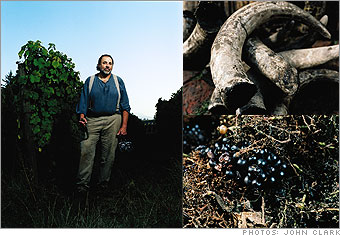 Tunnell uses cow horns and weeds to help grow his biodynamic vines.
Weedy wine
| Behind the scenes at the Boston launch of Virgin Money, Richard Branson's new peer-to-peer lending service. (more) |


