
CNNMoney.com
Companies Economy International Corrections Pre-market Trading After-hours Trading Winners/Losers/Actives Bonds Currencies Commodities World Markets Money Magazine Real Estate Taxes Jobs Ask the Expert Money 101 Autos Mutual Funds The Help Desk Loan Center Best Places to Live Ask the Expert Ultimate Guide to Retirement Retirement Calculators Best Funds Best Places to Retire Fortune Brainstorm Tech Apple 2.0 Blog Big Tech Blog Sectors and Stocks Tech Talk Resource Guide Small Business Makeovers Questions & Answers Small Business Video 100 Best Places to Launch FSB 100 Fortune Small Business Fortune 500 Brainstorm Tech Investing Management C-Suite Rankings Main Create Portfolio Edit Portfolio Create Alerts Edit Alerts

401(k)s and IRAs: Grow your money, shrink your taxes

How to invest for retirement so that you get rich - and the IRS doesn't.

Take your 401(k) with you
Protect It
Take your 401(k) with you
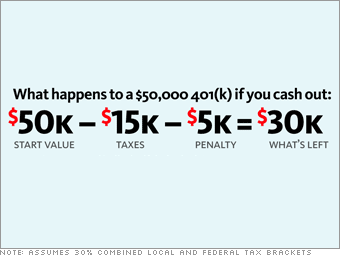
If you decide to change jobs, don't cash out your 401(k). Instead roll it into an IRA or transfer it toyour new employer's plan.

You can open a rollover IRA at virtually any bank, fund company or brokerage firm. What you get in return are more investment choices and greater flexibility. IRAs also give you more leeway in naming beneficiaries and arranging withdrawals.

There are some benefits to rolling it over to your new employer's 401(k). First, you may borrow from your account, an option that is not available with an IRA. Also if you retire at age 55, you maytake money out of your 401(k) without paying a 10 percent penalty, whereas you may not empty an IRA penalty-free until you turn 59-1/2, except with rare exceptions.

One final option is if your 401(k) at your former is employer is worth more than $5,000 you may leave it to collect later.

If you do decide to rollover you retirement account, have your former boss make out a check to your IRA trustee or the administrator of your new 401(k). If the check is made out to you, 20 percent will be withheldfor taxes in addition to a 10 percent penalty. To avoid paying taxes and the penalty, you must deposit the check - plus the 20 percent that was withheld - in a new IRA in 60 days. So don't even go there.
Your 401(k) A top priority Go for an IRA MONEY's best savings strategy Take your 401(k) with you When is converting to a Roth IRA the right move? Withdraw money sparingly, if ever, and never pay a penalty First things first Tax-deferred accounts come next Ready for the Roth IRA
Shawn Larsen, 47, has spent his career as a seismologist. Now he's thinking about biking and backpacking. Here's how he's saving to reach his goals. (more)
Before you even think of leaving your job, be sure your family is covered. (more)
Otis Braswell, 50, retired five years ago and cherishes the extra family time. But he's also learned an important lesson - golf isn't as much fun when all your friends are working. (more)
© 2009 Cable News Network. A Time Warner Company. All Rights Reserved. Terms under which this service is provided to you. Privacy Policy
Copyright © 2009 BigCharts.com Inc. All rights reserved. Please see our Terms of Use.
MarketWatch, the MarketWatch logo, and BigCharts are registered trademarks of MarketWatch, Inc.
Intraday data provided by Interactive Data Real-Time Services and subject to the Terms of Use.
Intraday data is at least 20-minutes delayed. All times are ET.
Historical, current end-of-day data, and splits data provided by Interactive Data Pricing and Reference Data.
Fundamental data provided by Morningstar, Inc..
SEC Filings data provided by Edgar Online Inc..
Earnings data provided by FactSet CallStreet, LLC.