
CNNMoney.com
Companies Economy International Corrections Pre-market Trading After-hours Trading Winners/Losers/Actives Bonds Currencies Commodities World Markets Money Magazine Real Estate Taxes Jobs Ask the Expert Money 101 Autos Mutual Funds The Help Desk Loan Center Best Places to Live Ask the Expert Ultimate Guide to Retirement Retirement Calculators Best Funds Best Places to Retire Fortune Brainstorm Tech Apple 2.0 Blog Big Tech Blog Sectors and Stocks Tech Talk Resource Guide Small Business Makeovers Questions & Answers Small Business Video 100 Best Places to Launch FSB 100 Fortune Small Business Fortune 500 Brainstorm Tech Investing Management C-Suite Rankings Main Create Portfolio Edit Portfolio Create Alerts Edit Alerts

8 forecasts for your financial future

You've come a long way since Money Magazine first hit the stands 35 years ago. So what do the next 35 years have in store for you and your wallet? We asked eight experts for their predictions.

The future of personal technology
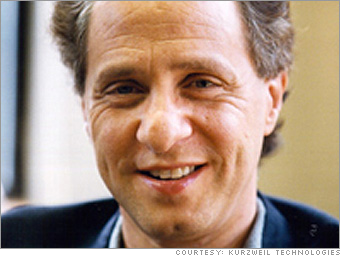
Ray Kurzweil is the founder of Kurzweil Technologies, a research and development company in North Andover, Mass.
Ray Kurzweil on:
The future of personal technology
Cell-sized robots will keep us healthy from the inside out.

About five years from now, tiny computing and communication nodes will be everywhere. The electronics we need will be woven into our clothing. We will have a very high bandwidth wireless connection to the Internet at all times.

Images will be written directly to our retinas from our eyeglasses, creating high resolution virtual displays. These displays will be able to overlay the real world and create an augmented reality - for example, information bubbles that pop up to remind us of people's names and birthdays.

Your search engine of choice will listen to your conversation and won't wait to be asked what to do. If it hears you wonder about "that actress, who played the princess in the early 'Star Wars,'" a popup will appear, saying, "Carrie Fisher played Princess Leia in episodes 4 through 6."

These displays will be able to replace real reality to create full-immersion virtual reality. Increasing numbers of Americans are already spending time in virtual worlds such as Second Life, with real economic transactions and real romance.

The cartoon-like visual presence of today's virtual worlds will evolve into highly realistic alternatives to real reality. That means you'll be able to overcome geographical distance at the touch of a (virtual) button, you'll have millions of virtual environments to choose from, and perhaps most interestingly, you can become someone else.

As amazing as that may sound, information technology will be a trillion times more capable (for the same cost) in 35 years. Scientists will have completed the reverse-engineering of the human brain, and we will apply the powerful methods of human intelligence to super-powerful computers.

The result will be a merger between our biological intelligence and the intelligent technology that we are creating. It will transform every aspect of our lives, from energy to our longevity. A few examples:
  • We will meet all of our energy needs with nano-engineered (engineered at the molecular scale) solar panels that are very efficient and inexpensive. We'll need to capture only about 3 parts in 10,000 of the sunlight that falls on the Earth to meet all of our projected energy needs.
  • Intelligent nanobots (robots the size of blood cells) will keep us healthy from the inside, augmenting our immune system and overcoming its many limitations. We will continually rebuild and rejuvenate our bodies at the cellular and molecular level, providing radical extensions to human longevity.
  • Billions of nanobots will go into our brains non-invasively, through the capillaries, and interact directly with our biological neurons. This will provide full-immersion virtual reality from within the nervous system, incorporating all of our senses.
Most importantly, technology will vastly extend our minds. By 2042, the non-biological portion of our intelligence will be far more capable than the biological portion. From my perspective, we will still be human, because I don't define "human" by our restrictions. Rather, we are the species that routinely goes beyond our limitations. That is a very old story, but it will go into very high gear over the next 35 years.

John
Bogle

Chris
Mayer

Margaret Regan

Paco
Underhill

Ray
Kurzweil

Uwe Reinhardt

Jason
Furman

Aubrey de Grey
In honor of Money Magazine's 35th anniversary, here are 47 smart ways to get on track to a rich life. (more)
Money Magazine collected the best advice from some of the smartest investors (and other people) who have ever lived. (more)
Money Magazine's survey of nearly 3,000 boomers found that they are reinventing the American dream. See some of the survey questions and results. (more)
© 2009 Cable News Network. A Time Warner Company. All Rights Reserved. Terms under which this service is provided to you. Privacy Policy
Copyright © 2009 BigCharts.com Inc. All rights reserved. Please see our Terms of Use.
MarketWatch, the MarketWatch logo, and BigCharts are registered trademarks of MarketWatch, Inc.
Intraday data provided by Interactive Data Real-Time Services and subject to the Terms of Use.
Intraday data is at least 20-minutes delayed. All times are ET.
Historical, current end-of-day data, and splits data provided by Interactive Data Pricing and Reference Data.
Fundamental data provided by Morningstar, Inc..
SEC Filings data provided by Edgar Online Inc..
Earnings data provided by FactSet CallStreet, LLC.