
CNNMoney.com
Companies Economy International Corrections Pre-market Trading After-hours Trading Winners/Losers/Actives Bonds Currencies Commodities World Markets Money Magazine Real Estate Taxes Jobs Ask the Expert Money 101 Autos Mutual Funds The Help Desk Loan Center Best Places to Live Ask the Expert Ultimate Guide to Retirement Retirement Calculators Best Funds Best Places to Retire Fortune Brainstorm Tech Apple 2.0 Blog Big Tech Blog Sectors and Stocks Tech Talk Resource Guide Small Business Makeovers Questions & Answers Small Business Video 100 Best Places to Launch FSB 100 Fortune Small Business Fortune 500 Brainstorm Tech Investing Management C-Suite Rankings Main Create Portfolio Edit Portfolio Create Alerts Edit Alerts

Stocks vs. Real Estate

Both real estate and stocks have had their day, but the question you need answered is this: Which contender is the superior long-term bet today?

Costs
Round 3
Costs
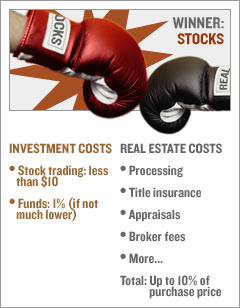
What leverage gives you, transaction costs take away. When you buy, you shell out for mortgage processing, credit reports, title insurance, appraisals, a lawyer for the bank, a lawyer for you, local transfer taxes and other charges. You may also pay a percentage point or more of the loan up front to lower your interest rate.

All in all, closing costs can run 2% to 4% of your purchase price. Sellers have to lay out a 6% commission for their agent, prepare a place for sale and, if it's their home, pay to move. Buying and selling can total about 10% of the purchase price.

Such costs make real estate a tough game. That $550,000 house (the one that gained 10% in two years) just turned into roughly a break-even proposition. And that total doesn't include the cost of maintenance and refurbishing, mortgage interest, taxes or insurance, which may add up to more than what you'd have laid out to rent a similar property.

Expenses run even higher if you are the owner of an investment property. You have to add the cost of advertising for tenants, evicting those who mess with you and carrying empty apartments.

In their study, Francis and Ibbotson didn't deduct such costs when they calculated returns. Had they, real estate would have fared worse. Stocks, by comparison, are incredibly cheap to own and sell. At a discount brokerage such as Scottrade, you can pay anywhere from $7 for an online purchase to $27 for one that is broker assisted.

Same when you want to dump your stock. A mutual fund that tracks a broad index of stocks can cost you as little as 0.09% of assets a year.

Performance Leverage Costs Taxes Transparency Effort Volatility Diversification Decision
Shoppers finally have the upper hand. Here's how to maximize that advantage. (more)
2 families were struggling to sell their homes. Money Magazine came up with 11 simple moves to help. (more)
These million-dollar mansions are located in neighborhoods where the median income can top $500,000. (more)
© 2009 Cable News Network. A Time Warner Company. All Rights Reserved. Terms under which this service is provided to you. Privacy Policy
Copyright © 2009 BigCharts.com Inc. All rights reserved. Please see our Terms of Use.
MarketWatch, the MarketWatch logo, and BigCharts are registered trademarks of MarketWatch, Inc.
Intraday data provided by Interactive Data Real-Time Services and subject to the Terms of Use.
Intraday data is at least 20-minutes delayed. All times are ET.
Historical, current end-of-day data, and splits data provided by Interactive Data Pricing and Reference Data.
Fundamental data provided by Morningstar, Inc..
SEC Filings data provided by Edgar Online Inc..
Earnings data provided by FactSet CallStreet, LLC.