
 When it comes to in-flight pampering, the amenity kits offered by these 10 airlines are the ultimate in luxury More
 From a text therapy platform to apps that push you reminders to breathe, these self-care startups offer help on a daily basis or in times of need. More
 From Uber's flying cars to the Hyperloop, these are some of the neatest transportation concepts in the works today. More


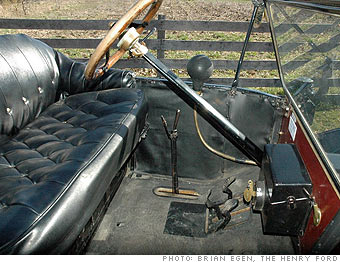
There is a steering wheel, of course, with a lever on either side. And there are three pedals on the floor. But none of them is the gas pedal and neither of those levers is the turn signal or wiper controls. (Neither or those are needed, since there are no turn signals or wipers) Those pedals are the spark adjustment and the throttle.
The first pedal controls the car's two-speed transmission. Press all the way down for low speed, half way for neutral and let it all the way up for high speed. (The hand-brake lever does double-duty by acting, when set half-way, as a blocker to keep the clutch pedal from going up past Neutral.)
The center pedal is for reverse and the one on the far right is the brake.
That's everything you need to know to get going. The rest just takes practice, foresight and some patience. Push the clutch pedal in to engage low speed while using your fingers to adjust the throttle to keep the engine from running too fast or slow.
Once you're moving along at a decent clip, pull all the way back on the brake lever and slowly - very slowly - let off the pedal to engage "high speed." The trick is to adjust the gas with your fingers while you let out the clutch to keep the the car from bucking and stalling or the engine from spinning itself to pieces.
This is when you realize you don't know how to stop this thing.
NEXT: Getting it to stop


 RSS
RSS