
CNNMoney.com
Companies Economy International Corrections Pre-market trading After-hours trading Winners/losers/actives Bonds Currencies Commodities Money Magazine Retirement Mutual Funds Taxes Ask the Expert Money 101 Autos Loan Center Best Places to Live Calculators Mortgage Rates Personal tech Big Tech blog Techland blog Sectors and stocks Fortune 500 techs Tech Talk 100 best places to launch Ultimate resource guide Small biz makeovers FSB 100 Ask & Answer Fortune 500 Technology Investing Management Rankings Main Create portfolio Edit portfolio Create Alerts Edit Alerts

Isn't it their turn to pick up the check?

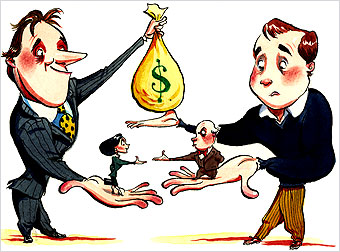
Money is great, if only it didn't get all tangled up with relatives. And friends. And kids. Our money & ethics advisers take your questions in their new book.

Friends as lenders, and the bank of quid pro quo
80 percent of people believe lending money to a pal is a good way to ruin the friendship.
Source: Fleming and Schwarz survey
Friends as lenders, and the bank of quid pro quo
Question: Two months ago Spencer, a good friend from college who now makes lots of money on Wall Street, lent me $6,000, interest-free, so I could pay off my credit cards, repay some debts and generally get back on my feet financially. The loan has been a great help, and I am paying Spencer back at the rate of $250 a month.

In the meantime, he has asked a big favor of me, namely to arrange an "information interview" for his new girlfriend with an editor at the magazine where I recently got a job in the art department. While I've met a couple of the editors, I don't really know them (and vice versa), and I'd prefer not to ask for this sort of favor - something I wouldn't hesitate to tell Spencer if I didn't owe him so much money. Does accepting the loan obligate me to do this for him? I feel like he's taking advantage of the fact that I owe him money.

Answer: The great thing about borrowing money from a bank is that they write down everything they expect of you. Friends are a different story. In this case, you've put yourself in a position where Spencer is not wrong to expect a big favor from you, since that's what you accepted from him.

What he can't expect, however, is for you to compromise yourself. Had he asked you to be a reference for a woman you scarcely know, he'd be crossing that line. But asking you to play a chip with your colleague is not unreasonable. After all, he's not requesting that you ask an editor to hire his girlfriend, just to talk to her. You owe him this favor, even if you'd prefer not to do it.

Test your ethics:
5. A friend is a month late repaying a $100 loan. Would you: a) do nothing. b) drop a hint. c) ask for the money.
Last updated February 14 2008: 1:18 PM ET

Sticky situations

Strings attached

Rich vs. poor

Good will

Pay for mistakes

Friends as lenders

The score
Tipping: Is it an obligation - or just an option - if your server was a complete jerk? (more)
I really don't need another sweater/gift card/pair of socks. Can't I just cut to the chase and ask for cash? (more)
I borrowed money, but my friend's son came with the deal. And now he's got to go. (more)
© 2008 Cable News Network. A Time Warner Company. All Rights Reserved. Terms under which this service is provided to you. Privacy Policy
Copyright © 2008 BigCharts.com Inc. All rights reserved. Please see our Terms of Use.
MarketWatch, the MarketWatch logo, and BigCharts are registered trademarks of MarketWatch, Inc.
Intraday data delayed 15 minutes for Nasdaq, and 20 minutes for other exchanges. All Times are ET.
Intraday data provided by Interactive Data Real-Time Services and subject to the Terms of Use.
Historical, current end-of-day data, and splits data provided by Interactive Data Pricing and Reference Data.
Fundamental data provided by Hemscott.
SEC Filings data provided by Edgar Online Inc..
Earnings data provided by FactSet CallStreet, LLC.