CNNMoney.com
Companies Economy International Corrections Pre-market Trading After-hours Trading Winners/Losers/Actives Bonds Currencies Commodities World Markets Money Magazine Real Estate Taxes Jobs Ask the Expert Money 101 Autos Mutual Funds The Help Desk Loan Center Best Places to Live Ask the Expert Ultimate Guide to Retirement Retirement Calculators Best Funds Best Places to Retire Fortune Brainstorm Tech Apple 2.0 Blog Big Tech Blog Sectors and Stocks Tech Talk Resource Guide Small Business Makeovers Questions & Answers Small Business Video 100 Best Places to Launch FSB 100 Fortune Small Business Fortune 500 Brainstorm Tech Investing Management C-Suite Rankings Main Create Portfolio Edit Portfolio Create Alerts Edit Alerts

401(k) losses? Get your money back

Don't let the market meltdown derail your future. Follow our six-step guide to rebuilding your 401(k).

2 of 6
BACKNEXT
2. Stick with stocks
Stick with stocks
Talk about lousy timing. After stocks have already fallen off the cliff, plunging 48.5% since peaking in late 2007, 401(k) investors are just starting to run for cover. In October, plan participants moved $776 million from equities into fixed-income assets, reports Hewitt Associates - one of the highest transfer levels ever. Meanwhile, the percentage of assets in stocks dropped five points to 54%, which is the lowest equity allocation in more than 20 years.

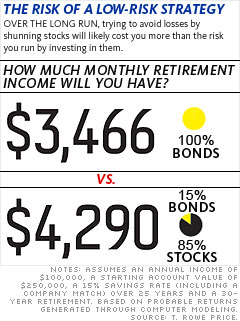
Fear of falling markets is understandable, but shifting entirely out of stocks would be a colossal mistake. Despite the market's meltdown, equities remain the only asset with enough growth potential to help you recoup your losses reasonably quickly and stay ahead of inflation longer term. Switch to all bonds now and, at the recent rate of 3.75% on 10-year Treasuries, you'll need about 12 years to make your money back (this assumes you started 2008 with a portfolio split 70/30 between stocks and bonds).

Moreover, given today's beaten-down prices, the prospects of earning above-average returns on stocks over the next market cycle look pretty good. By contrast, an all-fixed-income portfolio will generate much less income than a stock-bond blend when you're ready to retire.

NEXT: Fine-tune your asset mix
Last updated December 15 2008: 8:38 AM ET
More Galleries
Top-paying jobs Anesthesiologists take home a median $292,000 salary annually. What other great careers from Money and PayScale.com's list of Best Jobs in America offer big paychecks? More
Best holiday gifts for the homebody These goodies for the home will delight any nester, and won't cost you a fortune. More
Best holiday gifts for the gadget geek Looking for the perfect present for that tech-savvy someone in your life? Try one of these affordable gadgets. More

Special Offer
© 2009 Cable News Network. A Time Warner Company. All Rights Reserved. Terms under which this service is provided to you. Privacy Policy
Copyright © 2009 BigCharts.com Inc. All rights reserved. Please see our Terms of Use.
MarketWatch, the MarketWatch logo, and BigCharts are registered trademarks of MarketWatch, Inc.
Intraday data provided by Interactive Data Real-Time Services and subject to the Terms of Use.
Intraday data is at least 20-minutes delayed. All times are ET.
Historical, current end-of-day data, and splits data provided by Interactive Data Pricing and Reference Data.
Fundamental data provided by Morningstar, Inc..
SEC Filings data provided by Edgar Online Inc..
Earnings data provided by FactSet CallStreet, LLC.