CNNMoney.com
Companies Economy International Corrections Pre-market Trading After-hours Trading Winners/Losers/Actives Bonds Currencies Commodities World Markets Money Magazine Real Estate Mutual Funds Taxes Ask the Expert Money 101 Autos Loan Center Best Places to Live Ask the Expert Millionaires in the Making Ultimate Guide to Retirement Retirement Calculators Best Funds Ask the Mole Best Places to Retire Personal Tech Big Tech Blog Techland Blog Sectors and Stocks Fortune 500 Techs Tech Talk 100 Best Places to Launch Ultimate Resource Guide Small Biz Makeovers FSB 100 Ask & Answer Fortune 500 Technology Investing Management Rankings Main Create Portfolio Edit Portfolio Create Alerts Edit Alerts
Now it's time to put holdings in accounts where the IRS can do the least damage to them. (more)
Special Offer
4 of 7
BACK NEXT
4. A value fund
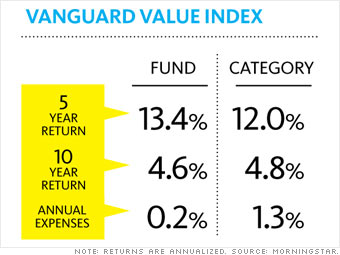
First choice: Vanguard Value Index (VIVAX)

The universe of equities is divided into two groups: growth stocks, which are shares of high-performing companies that often trade at steep prices (relative to their earnings growth or assets); and value investments, overlooked or beaten-down shares selling at discount prices. Why do you need to bother with the bargain-basement bin?

For starters, value stocks typically pay out significantly higher dividends than growth companies. Today, in fact, the average value stock in the S&P 500 yields 3.5% - nearly twice what growth stocks pay out. Dividends give value stocks a steadier source of return than growth funds, which rely almost entirely on the market's opinion. That's one reason that over long stretches, value trumps growth more often than not.

In the equity investors' bible, "Stocks for the Long Run," University of Pennsylvania professor Jeremy Siegel points out that value returned an average of 15.7% a year between 1975 and 2001, nearly two points a year more than growth stocks.

When choosing a value fund, the last thing you want to do is overpay. Vanguard Value Index is a cost-effective way to buy the universe of blue-chip value stocks for just 0.20% in annual fees. The low costs explain how this plain-vanilla fund has returned about 13% a year since 2003, beating 78% of its peers.

Alternatives: iShares S&P 500 Value Index (IVE) and T. Rowe Price Equity Income (PRFDX)

NEXT: A high-quality bond fund
Last updated May 15 2008: 1:29 PM ET
© 2008 Cable News Network. A Time Warner Company. All Rights Reserved. Terms under which this service is provided to you. Privacy Policy
Copyright © 2008 BigCharts.com Inc. All rights reserved. Please see our Terms of Use.
MarketWatch, the MarketWatch logo, and BigCharts are registered trademarks of MarketWatch, Inc.
Intraday data provided by Interactive Data Real-Time Services and subject to the Terms of Use.
Intraday data is at least 20-minutes delayed. All times are ET.
Historical, current end-of-day data, and splits data provided by Interactive Data Pricing and Reference Data.
Fundamental data provided by Morningstar, Inc..
SEC Filings data provided by Edgar Online Inc..
Earnings data provided by FactSet CallStreet, LLC.