CNNMoney.com
Companies Economy International Corrections Pre-market Trading After-hours Trading Winners/Losers/Actives Bonds Currencies Commodities World Markets Money Magazine Real Estate Taxes Jobs Ask the Expert Money 101 Autos Mutual Funds The Help Desk Loan Center Best Places to Live Ask the Expert Ultimate Guide to Retirement Retirement Calculators Best Funds Ask the Mole Best Places to Retire Big Tech Blog Techland Blog Sectors and Stocks Fortune 500 Techs Tech Talk 100 Best Places to Launch Ultimate Resource Guide Small Biz Makeovers FSB 100 Ask & Answer Fortune 500 Technology Investing Management C-Suite Rankings Main Create Portfolio Edit Portfolio Create Alerts Edit Alerts

5 fashion tips for your portfolio

U.S. stocks are down, bonds are dicey, and the stuff you don't own is way up. What's out of vogue and what'll stay in style?

1 of 5
BACK NEXT
Is indexing over?
Is indexing over?
Old style: It's the reliable way to win
New fad: In these rocky times, you can't afford to be average.

Index funds, particularly S&P 500 funds that track a broad measure of the U.S. stock market, have come to seem like a no-brainer. Most of us can't consistently pick market-beating stocks. But index funds will always give you the market average. And over the long run, they should fare much better than the average fund. Why? Unlike funds where pros choose the investments, they don't have high expenses eating up your gains.

Trouble is, the returns for S&P 500 index funds have been low in the past decade. Some managers who piled into smaller companies and overseas stocks not in the S&P have done better (often while taking more risk). But you can broaden your definition of the market and still index. Vanguard Total Stock Market follows nearly all U.S. stocks, with 28% of assets in small and midcap companies. Then you can add a foreign index fund to the mix for global exposure.

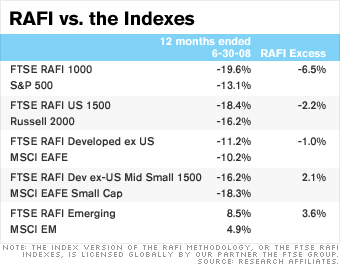
Meanwhile, a new breed of "fundamental indexers" claim to have a better formula. Rob Arnott, creator of an index tracked by some new funds, argues that the old indexes have a flaw: They weight stocks based on market value, so they end up owning more of the most overvalued companies. Fundamental indexes use alternative measures, such as dividends, to decide how much of a stock to own. If a fund based on those rules had existed 10 years ago, it would have beaten the S&P, according to Arnott's numbers.

Yes, but...Arnott's index tilts more to stocks with lower price-to-earnings ratios. That was great during a long slump for pricier growth stocks. But such trends often reverse, argues Vanguard founder John Bogle. Although betting on value isn't an extreme strategy, buying a fundamental fund still gets you back to trying to outsmart the market. Says Berkeley finance professor Terrance Odean: "It's like stock picking again."

The verdict: No need to get fancy now. Traditional indexing is still hard to beat.


NEXT: Should you fill up on foreign?
Last updated July 20 2008: 6:38 PM ET
More Galleries
The 10 dumbest iPhone apps The iPhone App Store launched a year ago with 500 applications. Today it has more than 55,000. Some are useful - many are plain stupid. With help from Krapps.com's Alex Miro, we've picked out some of the dumbest. More
New GM's new cars GM is launching a slate of new products. Can they give a lift to the auto giant as it enters a new era? More
Barbie gets a makeover As Barbie celebrates her 50th anniversary, middle age may be her time to shine (again). More

Special Offer
© 2009 Cable News Network. A Time Warner Company. All Rights Reserved. Terms under which this service is provided to you. Privacy Policy
Copyright © 2009 BigCharts.com Inc. All rights reserved. Please see our Terms of Use.
MarketWatch, the MarketWatch logo, and BigCharts are registered trademarks of MarketWatch, Inc.
Intraday data provided by Interactive Data Real-Time Services and subject to the Terms of Use.
Intraday data is at least 20-minutes delayed. All times are ET.
Historical, current end-of-day data, and splits data provided by Interactive Data Pricing and Reference Data.
Fundamental data provided by Morningstar, Inc..
SEC Filings data provided by Edgar Online Inc..
Earnings data provided by FactSet CallStreet, LLC.