|
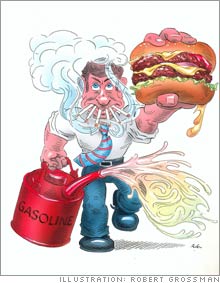
Thank you for eating, driving, and smoking Tired of taking a PR beating, big industry is fighting back.  (Fortune Magazine) -- They want you to laugh, to wince, to think. Just not to smoke. They're the "Truth" campaign ads - radio, television, and web spots that target kids at greatest risk for smoking. One ad shows teens unloading body bags in front of a tobacco company's headquarters. Ouch. "We've launched an edgy, proactive campaign that appeals to the rebellious nature of kids," says Dr. Cheryl Healton, president of the American Legacy Foundation, which sponsors the ads. "It's working."
Perhaps a bit too well. Lorillard Tobacco, which makes Newport cigarettes, has lately amped up long-running claims that the ALF breached the master settlement agreement (which provides for its modest budget) by creating ads that "vilify" tobacco companies. "We built in certain restrictions for how they can use the money, and they've violated them," says Ron Milstein, Lorillard's general counsel. Counters Ellen Vargyas, general counsel for the ALF: "Lorillard has stipulated that the content of our ads is true. How can the truth be vilifying?" The legal battle Only the Delaware Supreme Court knows for sure. If Lorillard wins the five-year battle (expect a decision any day), the ALF may lose its funding. In March, R.J. Reynolds (Charts), Philip Morris USA (Charts), and Brown & Williamson united to file an amicus brief on Lorillard's behalf. Big tobacco is not the only industry that's been putting up its dukes. In May, 18 food producers and restaurant trade groups organized a website to counter author Eric Schlosser's claims of food-industry abuse. (His latest book, Chew on This: Everything You Don't Want to Know About Fast Food, is aimed at teens, a cherished component of the fast-food-industry customer base; a movie adaptation of his previous bestseller, Fast-Food Nation, hits theaters this fall.) BestFoodNation.com, a red-white-and-blue website, offers food factoids and smiling farmers and company executives lauding our "safe, abundant, and affordable food system." But one editorial on the site labels Schlosser an anti-restaurant activist. And the author has been heckled and leafletted at public appearances, often at schools. Says Eamon Dolan, editor in chief at Houghton Mifflin, Schlosser's publisher: "The fast-food industry clearly believes that when you cannot refute the message, it is better to go after the messenger." Critics of global-warming science recently piggybacked onto former Vice President Al Gore's PowerPoint/documentary, An Inconvenient Truth, to promote their own ideas. The Competitive Enterprise Institute, a D.C.-based think tank specializing in "free-market approaches to environmental policy," created two 60-second television ads titled "Carbon Dioxide: We Call It Life," to address climate "alarmism." They ran in 14 cities in concert with the May 24 documentary debut. The CEI gets funding through the Petroleum Institute and has received more than $2 million from Exxon Mobil (Charts) since 1998. Damage control Why the pushback now? Technology is playing a role. "Consumers can connect in ways they never could before," says Daniel J. Howard of the Cox School of Business. To maintain its clout in the face of unwelcome criticism, big business will have to band together and invent ways to reframe the debate. But strategies can backfire, warns Michael Solomon, professor of consumer behavior at Auburn University. "Nothing helps if the refutations are so outrageous that they only reinforce the critics in the first place," he says. The global-warming ads, for example, drew mostly snickers. One of the scientists mentioned in the spot has publicly protested the use of his data. Outside the court of public opinion, the big guys still grind it out the old-fashioned way: On July 6, the Florida Supreme Court upheld a decision tossing out a $145 billion punitive-damages award against cigarette makers, capping a 12-year legal battle. Can snarky ads, grassroots campaigns, and splashy PowerPoints ultimately compete with deep pockets? Only time will tell. _________________________ From the July 24, 2006 issue
|
|