
Big Pharma's new R&D center: the trash binDrugmakers are getting desperate for growth, and are hoping a little serendipity might bring them the next Viagra. (Fortune Magazine) -- Making blockbuster drugs may be highly profitable - but it's never been efficient. A pharmaceutical company hoping to find, say, a new cancer drug will often invest seven or eight years and tens of millions of dollars only to end up with ... a drug that doesn't fight cancer. And then? Well, suck it up and start over. 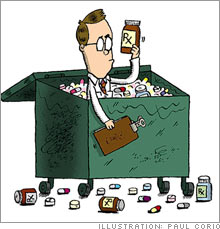 But wait, what if that failed cancer drug could cure athlete's foot? That sums up the new zeitgeist taking hold inside growth-starved Big Pharma, where a trend called "repositioning" is all the rage. Over the past year the industry's chief scientists have begun hiring specialty biotech firms to put their previously discarded experimental compounds - some that failed in clinical trials as long as 20 years ago - through batteries of new tests. The hope is that they'll stumble on a "happy accident" - when a medication intended for one treatment winds up being highly useful (and lucrative) treating something entirely different. Folly? Not necessarily. Consider that Pfizer's erectile dysfunction blockbuster Viagra started out as an experimental heart medicine - a $1 billion-a-year accident. Perhaps the most prominent player in this new game - amid scores of competitors, including a growing number in India - is Maryland's Gene Logic (Charts). Last winter the tiny, publicly traded biotech signed on with Pfizer (Charts) and Roche. And in October it announced a deal with Eli Lilly (Charts). The companies won't discuss the specific drugs or diseases they're reviewing - or the specific terms of payment. But Gene Logic CEO Mark Gessler says deals are typically structured so that his company receives milestone payments based on lab breakthroughs and then a "high single digit" percentage of sales if the medicines make it to market. So far Gene Logic and its peers have yet to find the new Viagra, but on paper, repositioning appears to work for everyone. As companies go after more difficult disease targets, Big Pharma is amassing huge arsenals of drugs that fail in the latter stages of clinical development. "This is one of the many things Big Pharma needs to be doing to improve productivity," says Frank Douglas, director of MIT's Center for Biomedical Innovation. "It makes sense to analyze a compound in as many diseases as you can." And for Gene Logic, one accident could make its shareholders very happy. ________________________ Big Pharma: Bad time to botch a blockbuster. Glaxo (Charts) (Charts), AstraZeneca (Charts) (Charts) stocks suffer on bad news over potential big-selling drugs. An antidepressant treats sexual dysfunction: J&J (Charts) says antidepressant drug extends intercourse. |
Sponsors
|


