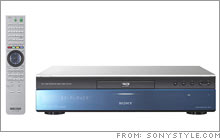
The trouble with SonyFortune's Brent Schlender explains why smart companies can be too smart for their own good. (Fortune Magazine) -- It's not every day that you see successful corporations humiliate themselves. But it happens. In the case of high tech, it usually occurs when a company can't resist the urge to launch a moon shot, a Herculean but overly ambitious and inevitably misguided effort to come up with some ultimate new thing. Sony, no stranger to embarrassment (remember the exploding batteries?), has not one but two big, expensive potential flameouts: the PlayStation 3 game console, and the Blu-ray DVD format.
Don't get me wrong. Sony is not run by numbskulls. There are good reasons for shooting the moon. For one thing, technology keeps morphing, and you have to keep up lest some upstart changes the rules of the game, as Microsoft (Charts) did to IBM (Charts) in days of yore. Then there's the natural urge to outdo the competition. And it takes a whopper of a product to goose growth when you're as big as Sony (Charts). The problem with moon shots is that you have to get the trajectory and the timing exactly right, or you wind up lost in space. Sony, despite spending billions on Blu-ray, missed. Not by much, but by enough to call into question whether its massive investments will ever pay off as it had hoped. I visited Sony's lab in Atsugi, Japan, in 1995 to see an early demonstration of a blue laser. Blue laser light is special because it has a much shorter wavelength than the red lasers in conventional CD and DVD players, and thus can discern much denser data on a disc, something absolutely necessary for showing video in high definition. I never did see the demo that day - the engineers reneged because the prototype was so finicky. But company officials bragged that it was a shoo-in to power the DVD players of tomorrow. Sony would, they assured me, be the sole owner of a new video format for the first time since Betamax. Alas, Sony soon learned that its marvelous blue lasers didn't last long enough to make a reliable consumer product. So in 1999 it turned to Nichia Corp., a little-known Japanese electronics maker that had devised a more durable blue laser - and took out 800 patents to protect the technology. A chastened Sony had to license Nichia's approach, and even so there was nothing to prevent Nichia from selling its own lasers or licensing Sony's rivals to make them too. Not surprisingly, a group led by Toshiba seized the chance to propose its own standard. Indeed, Toshiba's HD DVD format beat Sony's Blu-ray player to the living room by several months, and now both sides are in a full-fledged format war. Shades of Betamax vs. VHS. Also, because Sony waited to put Blu-ray technology in its PlayStation 3, Microsoft got its Xbox 360 to market nearly a year earlier. Even more humiliating, the PS 3 has been upstaged by Nintendo's Wii, a lower-tech but much hotter-selling machine. Some moon shots. What has to dismay Sony the most is the possibility that consumers won't care about Blu-ray. This month LG, a charter Blu-ray supporter, broke ranks and released a universal high-def DVD player that can display any kind of disc you throw at it - plain old DVD, Blu-ray or HD DVD. It's the ideal device for anyone who couldn't care less about formats and just wants to watch the damn movie. I tried one out, and even ordinary DVDs looked great. If an obsessive gadget freak like me can't get excited about Blu-ray, can anyone? So it goes with moon shots. Ford had its Edsel, Coca-Cola its New Coke, and 15 years ago IBM gave Microsoft its big break when it dragged its feet developing a graphical operating system for the PC. Microsoft got antsy and gave the world Windows. Now Microsoft has delivered Vista, a much-hyped operating system that has elicited mostly yawns. And there's a good chance another big launch - Apple's elegant iPhone, out this summer - could sputter as well. Why? Because, as Apple (Charts) and Sony - creators of two of the greatest small wonders ever, the iPod and the Walkman - should know, giant leaps for high tech aren't usually moon shoots. They're an accumulation of small steps. ___________________ |
Sponsors
|