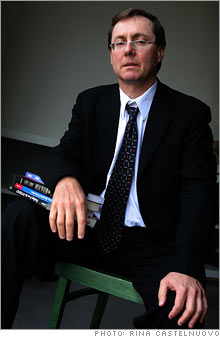
A corporate governance gadfly irks CEOsLucian Bebchuk's shareholder initiatives are shaking corporations, says Fortune's Geoff Colvin. (Fortune Magazine) -- He insists he isn't an activist. Plenty of America's CEOs must hope he means it. "I'm mainly a kind of ivory tower academic," says professor Lucian Bebchuk of Harvard Law School, and that he surely is - the only person I know of with four graduate degrees from Harvard (master's and doctoral degrees in law and economics). But as director of the school's Program on Corporate Governance he has also become America's most influential critic of CEO pay - to the deep annoyance of many CEOs, who say privately they wish he'd just be quiet. So now that he's behaving like a shareholder activist as well for the second proxy season in a row, the mere suspicion that it could be a new career cannot be comforting.
Bebchuk is best known for careful research that skewers the way CEOs get paid. From the bosses' perspective he has been distressingly energetic, not only writing a book ("Pay Without Performance") but also delivering lectures, contributing op-ed pieces, conducting seminars and testifying before Congress. Then, starting last year, he got into the game directly and changed it. Based on a particularly astute reading of corporation law that's too complicated to describe here, he filed a proposal with CA (Charts) (formerly Computer Associates), to be voted on by shareholders at the annual meeting, that would change CA's bylaws regarding the so-called poison-pill takeover defense. Bebchuk and many others see that mechanism as a management entrenchment device that hurts shareholders. His proposed bylaw change would let CA adopt a pill, but only by unanimous vote of the board, which would have to reaffirm the vote unanimously every year. CA said it wouldn't let shareholders vote on the proposal, arguing that it would violate the law of Delaware, where CA and most big companies are incorporated. The dispute went to court. Bebchuk won. CA held the vote, and his proposal got 41 percent - a huge number for a management-opposed proposal and enough to shake CA's board, which quickly replaced its pill with a new one that can be redeemed by shareholders. Companies usually regard professors as mere nuisances, but this was clearly different. Bebchuk was meddling with real power at a major corporation. As soon as he filed his CA proposal, corporate über-lawyer and poison-pill inventor Martin Lipton (who has represented CA) accused him of promoting a "pernicious" proposal with an "invidious purpose," namely tearing down anti-takeover measures. That didn't stop Bebchuk from filing proposals and forcing change at a number of other companies last year, all on bedrock issues of corporate power - poison pills and how directors get elected. And now he's back, this spring going after ten giants: AIG, Bausch & Lomb, Bristol Myers Squibb, Chevron, El Paso Natural Gas, Exxon Mobil (Charts), Halliburton, Home Depot, Time Warner (Charts) (parent of Fortune's publisher) and Walt Disney. The boards of Bristol Myers (Charts) and Home Depot (Charts) have already agreed to require that CEO pay be approved by a supermajority of independent directors. Disney (Charts) put his poison-pill proposal, similar to CA's, on the ballot, and it got 57 percent of votes despite management's opposition. That wasn't enough to change the bylaw, but Disney chairman John Pepper promised that the board would now give the proposal "serious consideration." The other seven companies will apparently go ahead with shareholder votes, fighting Bebchuk's proposals all the way. We'll see results in the coming weeks. What's next? "I don't expect to continue doing as much of this in the future," says Bebchuk, repeating that he's essentially a scholar. But he does think we'll see others doing more of what he did. Shareholder rights will get strengthened not by government action but through shareholder initiatives. "When changes come in this form, they have a kind of legitimacy that is hard to oppose," he says. "It's the market imposing certain arrangements." Bebchuk may back off his activism, but it's unlikely he'll cease to be a powerful irritant to CEOs. His latest push, for which he recently testified to a House committee, is for a law that would give shareholders a nonbinding advisory vote on executive pay. Even a shareholder advocate like me isn't sure about that one. But I'm certain the balance of power between shareholders and managers is still tilted too much toward managers. If an ivory tower academic trying to nudge it the other way really worries companies, maybe they really do have something to worry about. _____________ From the April 16, 2007 issue
|
Sponsors
|