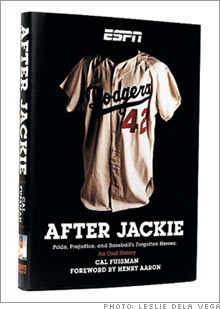
(Fortune Magazine) -- I don't think it's arguable: Of all athletic accomplishments in living memory, none was remotely as significant as Jackie Robinson simply stepping onto the grass at Ebbets Field wearing a major league uniform. It happened 60 years ago this month, an event now commemorated by "After Jackie: Pride, Prejudice and Baseball's Forgotten Heroes," by Cal Fussman (ESPN Books), an oral history told largely in the voices of African-American ballplayers who followed Robinson.
Like Robinson himself, the book is both a shocker and a spirit lifter. The shock comes from realizing what should have been obvious: Pathbreakers might lead the way, but they can't guarantee safe arrival for anyone else. Henry Aaron, Dick Allen, Frank Robinson and many other similarly proud and strong men testify how beset they were by fear, well into the 1960s and even beyond; how crippled by shame; and, in some cases, how enraged they remain - notably the great right-hander Don Newcombe, now 80, whose anguish and wrath spill onto the page with the force of a blow to the gut.
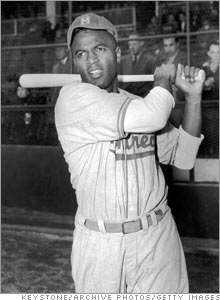 |
| Jackie Robinson |
The lift comes from two feelings nearly as intense: the gratitude some of these men express for those who treated them well - that is, like human beings - and their regard for Robinson's feat. The first category includes some long-acknowledged heroes (Pee Wee Reese) and some surprising ones (Rogers Hornsby).
The second is best expressed in the comment Maury Wills appends to a heartbreaking memory from 1955. Wills, who was a young minor leaguer trying to maintain his equilibrium after failing to find a meal and a decent place to stay in Beaumont, Texas, says, "Oh man, I know exactly what Jackie went through - except I failed utterly. What I don't know is how he succeeded."
Three less important things to note: The author's overearnest introductions to the chapters are unnecessary, at times even embarrassing; it's inexcusable that a book like this doesn't have an index; and for some odd reason Fussman includes my name in a very long list of people he thanks. It's odd because I had absolutely nothing to do with "After Jackie," but I can't say I'm displeased by the association.
Other books for the baseball season
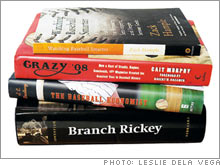
Some other books unveiled for the new season: "Branch Rickey: Baseball's Ferocious Gentleman," by Lee Lowenfish (Nebraska), is a solid (at 683 pages, you might say too solid) biography of the complicated man who brought Robinson into organized baseball.
"Watching Baseball Smarter: A Professional Fan's Guide for Beginners, Semi-Experts, and Deeply Serious Geeks," by Zack Hample (Vintage), would make an engaging gift for a friend who has no idea which end of the bat is up. Hample's book is both deceptive in its simplicity (the basic rules but also the ten different ways a pitcher can commit a balk) and surprising in its range. Why, for example, do Jorge Posada and Moisés Alou urinate on their hands? (To alleviate calluses, it turns out.)
In "The Baseball Economist" (Dutton), J. G. Bradbury attempts to apply the techniques of economic analysis to some of the game's complexities - a worthwhile effort, but I'm afraid Bradbury not only thinks like an economist but writes like one, too.
Then there's "Crazy '08: How a Cast of Cranks, Rogues, Boneheads, and Magnates Created the Greatest Year in Baseball History," by Cait Murphy (Smithsonian/Collins). Until that ball cantered through Bill Buckner's legs in 1986, the game's most famous mistake was the epic blunder known to generations of giggling schoolboys as Merkle's Boner. This momentous event led directly to the Cubs' last championship, and it serves as the pivot point of "Crazy '08." If Murphy weren't an assistant managing editor of Fortune, I wouldn't be constrained by the obvious conflict of interest that keeps me from telling you how beguiling a book it is.
An ex-ball player slides into stocks
Geniuses, idealists and nuts