
The darker side of shareholder democracyWhy the bosses (almost) always win in close shareholder votes. Fortune's Geoff Colvin counts the votes. (Fortune Magazine) -- It would be tempting for shareholders to feel triumphant just now, as they show startling power in the heart of annual-meeting season. At Hewlett-Packard (Charts, Fortune 500), United Technologies (Charts, Fortune 500), Bank of New York (Charts) and other companies, shareholder proposals on touchy issues like executive pay have won surprisingly strong support despite management opposition. At last shareholder democracy is working! 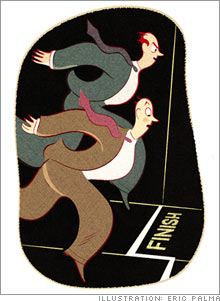 But hold on. In truth, shareholder democracy still isn't remotely like democracy as most people think of it. New research shows how twisted it really is and suggests why it could even be the source of the next big business scandal. The research comes from Yair Listokin, an associate professor at Yale Law School, who studied shareholder voting on proposals put forward by management. Those are critical votes, concerning mostly executive compensation but also merger approvals and other large matters. A majority vote is generally required, and much is riding on the outcome. When Listokin collected data on thousands of such votes, he discovered an amazing thing: On hard-fought issues with significant shareholder opposition, management frequently wins by tiny margins - just a couple of percentage points or even less - but almost never loses by tiny margins. Normally, of course, you'd expect hair's-breadth wins and losses to occur about equally. But in reality they aren't even close to equal. Listokin calculates that the odds of a chance occurrence of the vote distribution he observed are less than one in a billion. For perspective, consider that it's about 1,400 times more likely that you will be struck by lightning in a given year. In other words, it doesn't happen by chance. Does that mean that managers are illegally stealing elections? Not necessarily. Management's remarkable ability to win squeakers arises from a raft of features built into the system. Nothing like them exists in electoral democracy, except in banana republics. Put them all together, and "it's one big mess," says Listokin. "It makes Florida in the 2000 presidential election look like a model of vote-counting virtue." Most important is management's ability to monitor results as voting takes place. Shareholder votes stretch over days or weeks, and since the vote counter is typically paid by the company, managers can check running totals as proxy cards come in. Shareholders cannot. So if a vote is going badly, managers can get on the phone (or on corporate jets) to influence large shareholders who may not have voted yet. Because managers know how it's going day by day, they can target their efforts quite efficiently. Remember former Hewlett-Packard chief Carly Fiorina campaigning for approval of HP's merger with Compaq? She prevailed - with 51.4 percent of the vote. Management holds other advantages that are indisputable, though no one is eager to talk about them. For example, unlike in our political elections, Listokin observes, "exactly when the polls close is a bit fuzzy." That gives the vote tabulator some leeway in when to stop counting. While we vote only once in political elections, we can revoke and change votes in corporate elections. And most shares are held by banks or brokerages on behalf of others, so ballots don't always get to the right people. This results in massively complicated questions of which votes are valid. In our political system, representatives of both parties are in the room deciding such questions, but in corporate elections the shareholders are not present. Listokin emphasizes that he has no evidence of impropriety. But the incentives don't stand up well to scrutiny. In today's environment of growing shareholder power, this system seems unsustainable. "It's in the air that voting needs to be reformed," says Listokin, fresh from a conclave of corporate-law experts focused on this issue. "There's a feeling we need to do something before there's a scandal, a sense that this might be the next big thing waiting to happen." As we read the results of this season's shareholder votes, most of them won't be close. That's normal. But the votes that are close will represent some of the most important questions facing companies this year, and nothing suggests that management has lost its uncanny ability to get its way. It's hard to imagine that increasingly powerful shareholders will keep accepting the bottom-line reality for them as Listokin expresses it: "Just know that if it's close, you're gonna lose." From the May 28, 2007 issue
|
Sponsors
|


