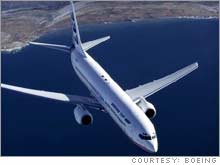
Stocks, bonds... or jetsAircraft are in such high demand these days that even hedge funds and private-equity firms are getting in on the action. Fortune's Barney Gimbel takes a look. (Fortune Magazine) -- Want a sure-fire way to make a cool million? Buy a Boeing 737 and flip it. There's only one problem: Good luck finding one. The worldwide demand for new and slightly used aircraft is so strong (and the supply so limited) that hedge funds have begun trading 75-ton Boeings and Airbuses as readily as they do crude-oil contracts. "Investors are out there sitting on $500 million, $1 billion [for buying planes]," says Scott Daniels of consulting firm BACK Aviation Solutions. "But finding aircraft is just so hard today, much less finding one at a good price."
In industry parlance, the plane deals are called "metal plays." After 9/11, when airlines started returning planes to creditors or demanding substantially lower lease rates, a few hedge funds saw an opportunity, but it involved a radical rethink of the way investors came up with valuations for planes. Traditionally, airlines purchased most of their fleets, renting the rest from a few big leasing companies owned by firms like GE (Charts, Fortune 500) and AIG (Charts, Fortune 500), which could afford to ride out the industry's ups and downs. But hedgies spotted a flaw in the model: Aircraft were financed based on the creditworthiness of airlines rather than the value of the actual planes. And with global demand for travel trending up, the funds bet that the metal could be alchemized into flying gold. It started small, with hedge funds buying individual planes, some of which were stored in the desert. Eventually they graduated from that buy-and-hold strategy to founding and building aircraft-leasing businesses. Cerberus Capital Management and Fortress Investment Group are two that stepped into the niche: In 2005, Cerberus bought DaimlerChrysler's minority stake in leasing firm Debis AirFinance (now AerCap) when the carmaker was cutting back on noncore operations. More recently Fortress's homegrown aircraft-leasing company, Aircastle, raised $240 million in an IPO last August. Eight months later Aircastle's shares were up about 30 percent. "Aircraft are great investments," says Ron Wainshal, the company's CEO, "because you can have an aircraft in America and two days later it can be in China. You can't do that with a building." Private-equity firms have been chasing metal too. Last month, just a year after it bought Morgan Stanley's 150-plane leasing business for $2.5 billion, the private-equity firm Terra Firma announced its purchase of Pegasus Aviation Finance for $5.2 billion. Run by London-based financier Guy Hands, Terra Firma now owns the world's third-largest plane lessor, after GE and AIG. With Boeing (Charts, Fortune 500) and Airbus largely sold out of new aircraft until after 2010, lessors can often name their price for popular aircraft, such as newer, single-aisle Boeing 737s or Airbus A320s, as well as some twin-aisle planes favored for lucrative long-haul routes. (For more, see "Boeing bets the farm," our interview with CFO James Bell.) Recently certain models have brought in as much as 1.5 percent of their market value in monthly lease payments, the high end of the industry's scale. Monthly rentals for newer-generation 737s, for example, are up almost 20 percent over the past two years; rates for 767s have doubled. "Recently we had two relatively new 737s returned from a European airline," says Eric Jones of GE Commercial Aviation Services. "Before we knew it, a bidding war started between five airlines." Since the red-hot leasing market is tied to the airline business, it's not for the risk-averse. But analysts claim that the recent spike in demand is different from the one that took place in the late 1990s. That's because airline growth isn't just confined to the U.S. and Europe, thanks to low-cost carriers popping up in emerging markets like China, India and Latin America. Boeing expects worldwide demand for air travel to increase by 260 percent by 2025, while the number of planes flying will just double. "This boom is not just hype," says Bob Peart, managing director of Guggenheim Aviation Partners, which is starting its second aircraft investment fund. As U.S. carriers begin to replace their fleets, demand for new aircraft will only increase. Right now domestic carriers own 126 airplanes that are 25 to 40 years old. Without new orders, that number is expected to grow to 384 airplanes in 2012 and up to 840 by 2015. Too bad the airlines aren't in the aircraft business - maybe then they'd actually make money. From the June 11, 2007 issue
|
Sponsors
|