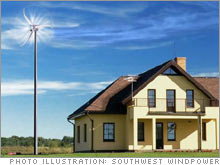
Your own windmillInnovative new turbines bring wind power to the home market. NEW YORK (FORTUNE Small Business Magazine) -- Ever look at your power bill and wish you could do something about it besides running around turning off lights? This summer Southwest Windpower (www.windenergy.com) of Flagstaff, Ariz., will introduce a wind turbine just 45 feet high (compared with 100 feet for a conventional model). The turbine, now known simply and prosaically as Beta 1.8, will produce electricity even at modest wind speeds. Suitable for properties as small as half an acre--whether homes or businesses--it could extend the windmill option to a much larger portion of the U.S. Says David Calley, Southwest Windpower's co-founder: "We're going to crack a totally new market." Calley, 42, is an alt-energy nut. At age 12, he built a primitive windmill that produced electricity for his bedroom--for a single bulb and the cassette player on which he listened to Pink Floyd. In 1982, Calley dropped out of college and founded Southwest Windpower. The company has since grown to 60 employees and $10 million in annual revenues. It's the world market leader (with a 35% share) in so-called small wind, a category distinct from the huge turbines deployed on wind farms. Southwest's turbines provide power to boats and to houses off the electrical grid, even to base camps on Mount Everest. But breaking into the residential windmill market has long been a dream for Calley. Other firms have tried similar projects, almost all unsuccessfully. In 1980, Southwest Windpower's main competitor, Bergey Windpower of Norman, Okla., launched a small residential turbine but sold just 800. The windmills were simply too small to catch much wind. Calley says the Beta 1.8 will feature a new alternator he invented that operates with very little friction, and a new blade design (shaped like a samurai sword) that can produce electricity in wind speeds as low as five miles per hour, vs. ten for a conventional small-wind turbine. As for noise, Calley says customers will hear only a quiet swishing sound of about 45 decibels, the level of bird chirping. (Of course, buyers in some regions will face a thicket of local zoning laws.) He plans to retail the Beta 1.8 for $6,000. The turbine will be plug-and-play: a single, integrated unit that connects directly to a house's circuitbreaker panel. According to Southwest, it will save the average household $500 a year, based on current energy prices, and pay for itself in 12 years. Depending on where you live, you could also qualify for tax breaks and incentives for using a turbine. Now all Calley needs is a better name for it. The debate about global warming continues. Read more. Brace for summer gas pains. Click here. |
Sponsors
|