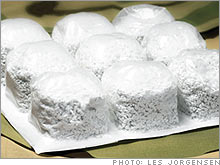
Building a business on blocking bombsTwo entrepreneurs hope to protect humanity from explosions. (FSB Magazine) -- The AHA! moment arrived over breakfast in an Orlando diner. James Gordon and John Waddell were trying to develop a product designed to protect lives and property from the deadly effects of bombs and industrial explosions. Their first idea was a stiff plastic or paper honeycomb panel filled with perlite, a volcanic glass commonly used as loose-fill insulation in masonry construction and as an ingredient in soil-free growing mixes for horticulture. Perlite dissipated explosions quite well in early tests, but the honeycomb casing proved too rigid and too expensive. Gordon and Waddell needed a material to contain the perlite that was tough, light, bendable and cheap. "The concept was great," recalls Gordon. "The packaging was impossible." Then they spotted their solution sitting in plain sight on the breakfast table: Smucker's jelly containers.
Waddell and Gordon are sixtysomething veterans of the real estate and steel industries, respectively. They teamed up to launch BlastGard International (Charts) (blastgardintl.com), a small public company based in Clearwater, Fla. After two years and $2.5 million in private financing, BlastGard landed its first major customer in 2005. To date the Washington, D.C., Metro rail system has ordered 208 explosion-mitigating trash receptacles for use on Metro platforms (total cost: $797,000). The containers are lined with BlastWrap, two layers of thin white plastic sealed together to form pockets about three inches square and one inch deep. Each pocket is filled with a white, sand-like compound of perlite and salts, which contains water. Sliced apart, the individual pockets could be little diner packages of Smucker's. BlastWrap essentially diffuses the energy of an explosion. The explosive shock wave ruptures the plastic packaging and breaks down the perlite mixture, filling the blast area with perlite dust and droplets of water released from the pulverized salts. The dust dissipates the shock wave while the water douses the fireball - all in a few milliseconds. BlastGard's second big order came from Amtrak in early 2006: $959,000 for 236 trash receptacles for railway stations in New York City, Philadelphia, Chicago and elsewhere. But shielded trash cans are just the beginning. Waddell and Gordon want to sell BlastWrap to anybody who handles explosive materials. Target customers include airlines, the military and the petrochemical industry, but frequent fliers will welcome one application in particular. In collaboration with Nordisk Aviation Products, a Norwegian company that produces most of the aluminum freight containers used on wide-body aircraft, BlastGard has developed - but not yet sold - a shielded container designed to smother suitcase bombs. The problem is that BlastGard's container sells for about $2,900, compared with $1,000 or so for an unprotected container. BlastGard can't reduce the price until it builds a volume business. But the struggling airline industry isn't likely to cough up the extra money unless regulators or insurers insist. So far, they haven't. Military forces around the world are a major target of opportunity for BlastGard. A pad of BlastWrap on the bottom of a Humvee, for example, would complement the vehicle's armor plate. Conventional armor is pretty good at blocking the shock wave and shrapnel from a mine or from the homemade explosives that litter roads in Iraq. But armor plate also compounds the jolt that tosses the vehicle, often causing serious injury to its occupants. BlastWrap would reduce that bone-breaking whump. In November, BlastGard announced that it had signed a $186,000 deal to provide its products to the U.S. Marine Corps for use in Iraq and Afghanistan. The company also named L. Paul Bremer, former administrator of the Coalition Provisional Authority in Iraq, to its board. Amid the good news lurks the risk that this small company could choke on the sheer variety of its opportunity. BlastGard's SEC filings and marketing materials catalog a multitude of possible Blast-Wrap applications, few of which have yet attracted customers. For the first nine months of 2006, BlastGard posted an operating loss of $1.2 million on just $197,000 in sales. Numerous competitors are developing alternative blast mitigators, including metal alloy mesh and foamed metals. And the company's easily fabricated material is certain to attract knockoff artists. Gordon and Waddell have filed a patent application to protect their multimillion-dollar investment in BlastWrap. But if the duo can overcome the near-term challenges, their company's potential, in this era of terrorism and war, would be explosive. To give feedback, please contact us at fsb_mail@timeinc.com. From the April 1, 2007 issue
|
Sponsors
|