|
U.S. consumer credit soars
|
 |
January 8, 2002: 4:12 p.m. ET
Consumer debt posts record jump in November, led by auto loans.
|
NEW YORK (CNN/Money) - U.S. consumer credit jumped by a record amount in November, the nation's central bank said Tuesday, thanks in large part to an enthusiastic response to automakers' zero-interest loans.
Consumer debt rose 14.6 percent, or $19.9 billion, in November to a seasonally adjusted $1.653 trillion, the Federal Reserve reported, compared with a revised 8.3 percent, or $11.2 billion, gain in October. Economists surveyed by Briefing.com expected an increase of just $5.1 billion.
The gain was led by an 18.3 percent surge in "nonrevolving" credit, of which auto loans are a major part, to $958 billion. Automakers enticed consumers to buy new cars with zero-percent loans in late 2001, and consumers responded in droves.
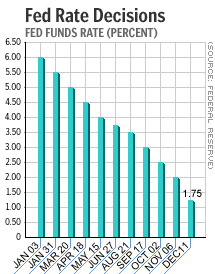
The Fed also tried to encourage consumer spending in 2001 by cutting short-term interest rates 11 times, a record for a calendar year. The economy sank into a recession in March, according to some economists, but the Fed's efforts apparently supported consumer spending and confidence, as well as the housing market, helping fuel a recovery early in 2002.
On the other hand, high levels of debt as reflected in the Fed's report have more cautious economists worried that consumer spending will be muted in the coming months, especially with an unemployment rate rising toward 6.0 percent, tempering a recovery.
"This really reduces the chance of a cyclical bounce in spending, which is what we typically expect to see in a recovery," said Lara Rhame, an economist with Brown Brothers Harriman.
U.S. gross domestic product (GDP) shrank in the third quarter and will likely shrink again in the fourth, matching the common definition of a recession; and the respected National Bureau of Economic Research said a recession actually began in March. Most economists expect a recovery in the first half of 2002.
But recent remarks by Fed officials indicate they're not entirely convinced a recovery is right around the corner, leading some economists to believe interest rates could stay low for longer than most observers and the financial markets expect.
"A number of sectors will need to transition before we can be confident of an acceptable level of economic activity," Philadelphia Fed President and policy committee member Anthony Santomero said in a speech before the Philadelphia Chamber of Commerce.
Factory orders dipped in November, the Commerce Department reported earlier Tuesday, slightly more than expected. Though most of that drop was due to a return to normalcy after a dramatic surge in demand for military aircraft in October, the data were indicative of an economy still struggling to recover. 
|
|
|
|
|
|

|