BEND, Ore. (CNN/Money) – You say you want to buy a house. Before you start dreaming about floor plans and chatting with real estate agents, do yourself a huge favor: Check your credit score.
Your credit score, or FICO score, is a rating created by Fair Isaac to boil down all of the information in your credit report to three digits, ranging from 300 to 850, that tells lenders how likely you are to pay back your loan.
"Over the last five years, credit scores have been refined to the point where they are now one of the most important factors for lenders," said Anthony Hsieh, CEO of HomeLoanCenter.com.
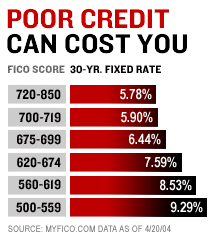
Although lenders interpret credit scores differently, they usually reserve the best interest rates for borrowers with solid credit, or scores of about 700 or higher. Borrowers with scores in the low 600s, on the other hand, are considered risky investments and warrant higher rates.
In fact, recently a borrower with a score of 720 to 850 would pay 5.78 percent for a 30-year mortgage, while someone with a score of 620 to 674 would pay 7.59 percent, according to MyFICO.com, a division of Fair Isaac.
On a $150,000 mortgage, that's the difference of $180 a month in mortgage payments and about $65,000 in interest over the life of the loan. Who would have thought three little numbers could mean so much?
What's in a score?
Any time you take out credit, your information – including whether you pay your bills on time and how close you are to your credit limit – is reported to the three major credit bureaus, Equifax, Experian and TransUnion. As long as you've had one line of credit open for at least six months you probably have a credit score.
Under the Fair Credit Reporting Act, you can request a free copy of your credit report from all three of credit bureaus if you've been denied credit. But, if you want to see your credit score, you'll have to pay. In fact, because each of the three credit bureaus maintains an individual report for you, you actually have three scores.
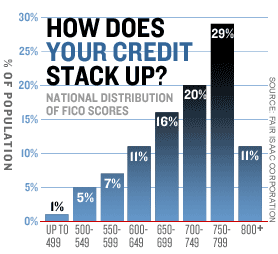
You can access credit scores from all three bureaus at myFICO.com, which is run by Fair Isaac. For $12.95 per score you'll get an explanation of how your score is likely to affect your credit, information about what is helping and hurting your score and a snapshot of your credit history. (For $38.85 you get all three, as well as the full-blown credit reports.)
"The scores should be pretty close, but there can be discrepancies," said Ryan Sjoblad, a spokesman for Fair Isaac. Those discrepancies are likely to be the result of errors in your credit report.
Some errors are obvious -- such as an account that doesn't belong to you -- while others are less easy to pick out. For example, if the credit limit on your home equity line shows up as being smaller than it actually is you may be penalized for being too close to your limit.
| Related articles
|

|
|
|
|
To correct an error, contact the creditor directly and request that it update all three credit agencies and send you a copy of the correspondence for your records. Keep in mind, though, that it can take quite a while for these corrections to be reflected in your score.
If you don't have immediate plans to buy a home, you may be able to further improve your score by consolidating accounts or transferring balances, said Chris Viale, general manager for Cambridge Credit Counseling. For example, if you have several department store credit cards near their max, you might benefit by moving all three balances to a low-interest credit card with a higher limit, he said.
Just be careful, said Sjoblad, If you're applying for a loan in the short term it's probably not a good idea to open, close or consolidate accounts. "This could shorten your credit score or make it appear that you are near your credit limits," he said.
In any case, the biggest improvement to your score will come with time and responsible credit management. According to Sjoblad, the most important thing you can do is simply pay your bills on time and aggressively pay down your consumer debt.
It's not unreasonable to raise your score by 20 points within six months -- enough to make a difference in your interest rate.

|




