BEND, Ore. (CNN/Money) -
In hindsight, it wasn't the high P/E ratios or absurd IPOs that marked the height of the stock market in the late 1990s.
It was the dimwitted brother-in-law bragging about what a killing he'd made on Pets.com (on paper of course), the college kid hanging on Maria Bartiromo's every word, and the soccer mom explaining how you couldn't lose in "the new economy."
Fortunes were lost. Attitudes changed.
But not for long.
Now that dimwitted brother-in-law is bragging about the killing he's made on rental houses in Las Vegas (on paper of course), the college kid has dumped Bartiromo for "Rich Dad, Poor Dad" author Robert Kiyosaki, and the soccer mom is quick to point out that you simply can't lose with real estate.
Does all this enthusiasm spell trouble?
"I would say a bubble is happening," said Robert Shiller, whose book "Irrational Exuberance" (Princeton University Press, 2000) warned, correctly, that the stock market was grossly overvalued by investors' unfounded optimism.
"When it's going to burst is the real question," he said. "It's difficult [to know]."
The Yale economist and principal at real estate firm Fiserv Case Shiller Weiss is now working on the book's second edition, which will among other things look at whether America's obsession with the stock market has been displaced by exuberance for real estate.
During a housing bubble, he said, buyers who would otherwise consider a house too expensive go ahead and buy anyway because they overestimate future price appreciation and underestimate risk. The bubble bursts, or deflates, when buyers are no longer so sure that prices will continue to increase.
"The essence of a bubble is investor enthusiasm," said Shiller.
If the CNN/Money inbox is any indication of investor sentiment, confidence in real estate has been quite high. Some might say too high.
"I just started to invest in RE last year. So far I made $60k and $38k on my first investments, $5k on my third," wrote one reader. "This is just the beginning folks!"
Wrote another giddy investor: "I just turned 30 years old, and in less than 4 years I've become a real estate millionaire (on paper)."
Not everyone is so smitten with real estate. One of the handful of skeptics we've heard from is, interesting enough, a loan officer in Denver. "Clearly people are buying beyond their means," he said. "It's a frenzy, and everybody wants in."
Are you irrationally exuberant?
While you can't time the housing market, you can make sure your decision to buy doesn't defy reason.
You know you're exuberant if...
- You "learned your lesson" when stocks tanked. Now everything is in real estate. If there's one thing the dot-com debacle should have taught you, it's to diversify. Aim to have no more than 30 percent of your net worth tied up in real estate.
- You use your credit card to make a down payment. It's cheaper than paying private mortgage insurance or borrowing from a home equity line of credit, you reason. So what if a couple late payments can take that 0-percent teaser rate to 20-percent in no time?
- You tap your home equity line to pay your mortgage. Exuberant buyers take on higher mortgage payments than they can afford thinking they can deal with being "cash poor" while their house magically doubles in value.
- You opted for a one-year ARM to get the cheapest rate. Adjustable rate mortgages that are fixed for at least five years make sense if you know you're not going to own a house for 30 years. If a one-year ARM is the only way you can afford to buy, consider renting.
- You buy a second home in a "hot" market you've never visited. It's not enough to own one house. You start chasing returns in cities you know little about.
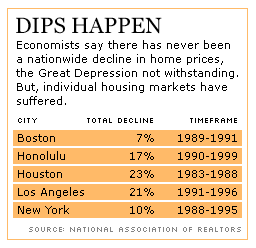
- You believe real estate never goes down. There has never been a national decline in housing but individual metros, such as Los Angeles and Honolulu, have suffered declines. These weren't short-term "buying opportunities" either.

|



