|
NEW YORK (Business 2.0) -
To understand how advances in computing technology are affecting the petroleum industry, look no further than the Pod. Designed by Landmark Graphics, a unit of Halliburton that specializes in developing software for oil companies, the Pod is an Imax-style viewing room powered by a supercomputer.
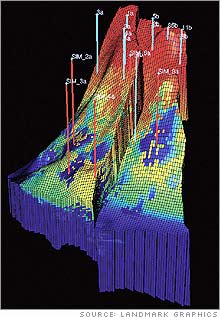
With a 45-foot screen and a 64-bit Unix-based operating system designed by Silicon Graphics, the Pod enables oil companies such as Shell and Chevron to create astonishingly accurate 3-D seismic models that highlight strata where oil and gas pockets lurk, taking much of the guesswork out of the drilling process.
Specialized software from companies like Landmark and new, low-cost supercomputers are bringing petroleum exploration and recovery closer to being an exact science.
In the North Sea, Norwegian petroleum giant Statoil is using the latest software to help it position wells for optimal recovery from deposits at the bottom of the ocean. Statoil estimates that its IT initiatives will bring in an additional $400 million from its existing wells while saving $20 million in drilling costs over the next several years.
Advances in sensor technology and seismic surveying are also helping drillers find new oil, making the extraction process more efficient by orders of magnitude. Pressure and temperature sensors are beginning to supply companies with accurate profiles of wells and reservoirs to help them optimize the rate at which oil is withdrawn.
Next: Oil shale

|