
Forget gas: Get ready for $4 a gallon milk
Higher costs for feed and fuel are driving farmers to cut back on milk production - and that means higher prices.



 |
| Dairy farmer Rich Byma is forced to cut back on milk production because of soaring costs of feed and fuel. |

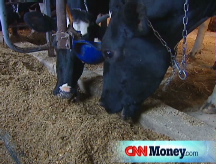

NEW YORK (CNN) -- Dairy farmer Rich Byma pushes a huge bin packed with a feed mix of corn, soybeans, vitamins and minerals through his barn, delivering a morning meal for his 300 cows. As his milk-producers munch, it's like seeing them eat dollar bills for the veteran farmer because the cost of feed is at an all-time high.
"Corn meal has doubled in price since a year ago," said Byma who has been running his family's By-Acre Holsteins Farm in Wantage, New Jersey for 36 years.
Feed accounts for close to half of the farm's operating expenses. So, farmer Byma is responding to the sky-high price of corn and soybeans by putting his cows on a diet.
"We watch every pound of feed we give to the cows," said Byma. "We are very conservative."
Putting his cows on a diet means more than a trim underbelly for Elsie. When cows eat less they produce less milk.
The U.S. Department of Agriculture says many farmers are doing the same.
"Our projections show for the balance of the year we'll see milk production slacken and then prices should firm," said Roger Hoskin, Milk Analyst for the USDA.
Milk prices have eased in recent months after skyrocketing last year. The national average price of a gallon of whole milk was $3.72 in April, after peaking at $3.87 last September, according to a USDA survey.
As milk prices climbed 17% last year, as measured by the USDA survey, farmers responded by increasing production while consumers reduced consumption. That rise in supply and drop in demand resulted in the recent price drop.
But now, dairy experts say, the trend is about to reverse.
"As we get into late summer, into the fall we'll see higher milk prices because the equation doesn't work for a farmer with $6-a-bushel corn and a $115-barrel of oil," said Ed Gallagher, Vice President of Economics and Risk Management for Dairylea Cooperative Inc.
The By-Acre Holsteins last year were CASH COWS. As the price of milk soared, so did profits on Byma's farm. But now Byma is confronting not only high feed costs, but also rising expenses for diesel fuel, necessary for running farm equipment and transporting his daily load of 7,500 pounds of milk to the Dairylea Cooperative.
"Our profit margins are getting tighter and closer because of the high cost of feed and energy," said Byma.
The farm now generates about 60-cents of profit on every "hundred-weight" (100-pounds of milk, which is about 11-1/2 gallons), a fraction of last year's earnings.
"It's very, very tough for the farmers now," said Dennis Nearing, President of Cocheton Mills, Byma's feed supplier.
"It's a constant that comes up. 'What can I do to cheapen the feed?'," said Nearing. "There isn't much you can do."
"It's gotta change. They gotta get more for their milk."
The average price of milk is already above $4-a-gallon in Baltimore, New York, Miami, Minneapolis and New Orleans, according to the USDA. If feed and fuel prices keep climbing, dairy experts predict the national average later this year will also top $4-a-gallon. 



