
Think gas hurts? Try diesel
Record-high diesel prices have cut into truckers' profits, and members of the House Transportation Committee are searching for solutions.



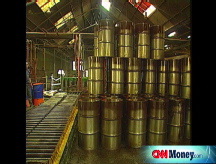
NEW YORK (CNNMoney.com) -- Rising diesel prices have slammed the trucking industry and hurt independent truck drivers, and Congress is looking for solutions.
Members of the House Committee on Transportation and Infrastructure on Tuesday took up the rising diesel prices issue that has hampered the trucking industry.
"People are losing their trucks and losing their business," said Rep. Peter DeFazio, D-Ore. "But there are some places where an appropriate action by Congress might mitigate these problems."
The cost of diesel has risen 26% since the beginning of this year, compared to an 18% increase in the price of regular gas. The national average price for diesel reached a record high of $4.25 a gallon on May 1, while gasoline reached a record $3.62 a gallon, according to AAA.
Rising diesel costs have dug into the profits of the trucking industry, whose trucks run on the fuel. The American Trucking Association predicted that truckers will have to shell out $140 billion for diesel in 2008, sharply higher than the $112 billion they spent in 2007.
"If you're in the trucking industry, you've got a very critical situation on your hands," said Rep. John Mica, R-Fla. "We need a long-term policy but we also need a short-term policy - the short-term policy needs to be an increase in supply and to tap our domestic resources wherever they be."
In a protest of record high fuel costs, hundreds of truckers circled the U.S. Capitol on April 28.
Over the past 12 months, the dollar has plummeted more than 10% against global currencies, and oil has climbed about 80%. As the dollar continues to depreciate in value, investors have bought oil futures as a hedge against inflation.
Also, oil is priced in dollars worldwide, so a falling dollar provides less incentive for oil-exporting countries to increase output, or for foreign consumers to cut back on oil use.
Per gallon of diesel, crude oil makes up about $2.80, according to Todd. And as oil prices hit a record $122 a barrel Tuesday, there were no immediate signs of diesel prices retreating.
"The No. 1 problem with gasoline prices is high crude prices," said Deutsche Bank oil analyst Ryan Todd in testimony.
Many energy industry analysts blame oil speculators for cashing in on the fuel cost crisis and, in the process, boosting the price of oil.
"There are many practices by hedge funds that fall below the radar screens of federal regulators," Tyson Slocum, director of the energy program at public interest group Public Citizen, testified at the hearing.
After a Goldman Sachs analyst predicted oil could rise to $200 a barrel in 2008, Slocum said the prediction itself sends speculators to the market, because "the high bar has been set for traders."
Also contributing to rising diesel prices is that global demand for the fuel has outpaced that of gasoline over the past 12 months. Industrial expansion in China and a rising number of cleaner-burning diesel cars in Europe have boosted demand. Additionally, the new ultra-low sulfur formula for diesel that was introduced in 2006 costs more to produce and has affected production levels.
But the solutions may be as complex as the problem.
DeFazio suggested government regulation on speculative trading would help keep oil prices down, but he was met with stiff opposition by American Petroleum Institute chief economist John Felmey. In testimony, Felmey said that market fundamentals of supply and demand are driving prices - not speculative trading.
Todd was skeptical of speculators' impact on oil prices, saying, "The effects of speculation are just that, speculation."
But when pressed by DeFazio about regulation, he conceded, "It wouldn't cause undue harm."
Oil companies are another popular target for consumers' critique. With historic profits for corporations such as ExxonMobil (XOM, Fortune 500) and Chevron (CVX, Fortune 500), coupled with rising gas prices, big oil has become public enemy No. 1 for the public and Congress.
In fact, according to a new poll released Monday by CNN, 83% of Americans believe that oil companies' profits are too high.
However, some analysts said placing blame with the oil companies is misguided.
"Targeting oil companies won't help consumers ... and price controls also won't work," said Felmey, who told the panel that imposing regulation on oil companies would ultimately cause fuel prices to rise.
"Their earnings are not as impressive as the rhetoric may suggest, amounting to only about 7 cents per dollar," he added.
A proposal to raise the federal fuel tax, which currently stands at 18.4 cents for a gallon of regular gasoline and 24.4 cents for diesel, met mixed reaction from the witnesses. The gas tax is unchanged from when it was introduced in 1993.
Slocum said raising the gas tax would help control demand and ultimately bring fuel prices down, but he objected to placing that burden on the consumer.
Todd said a higher gas tax "would be tough to get through here in Washington, but is probably not a bad policy."
But Felmey rejected it, saying a more viable solution to rising fuel prices lies in expanding more of nation's petroleum reserves and investing in non-finite alternate fuels.
"We need alternative fuels ... but we don't need to be price-gouged on our way there," DeFazio retorted. 



