
Lenders foot the bill for abandoned homes
Foreclosed homes that lie vacant and rundown need their lawns mowed and their yards cleaned up. Cities say taxpayers shouldn't have to bear that burden.



 |
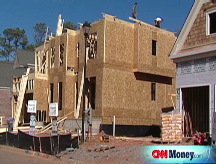
| Abandoned homes line Slavic Village streets in Cleveland |
| Special Report |
 |
NEW YORK (CNNMoney.com) -- Weeds stand waist high on the front lawn of the wood-frame, single-family house in Cleveland's Slavic Village neighborhood. Trash spills out open doorways into the driveway and yard.
The city will have to pay someone to come in and clean up the lot, board up the windows and cut the lawn. Similar scenarios are playing out in communities all over the country wracked by soaring foreclosure rates, where vacant, rundown homes are springing up as quickly as the weeds in their yards.
But now these communities are fighting back, demanding that property owners - often the banks that repossessed the properties - pay to keep these houses from falling into disarray. The state of California as well as Providence, R.I., and Trenton, N.J. are all pushing initiatives to prevent taxpayers from having to bear the burden of the housing crisis.
"Cities are trying to push the costs of maintaining these properties off on the people holding title to the properties," said Chris Hoene, director of policy for the National League of Cities.
It's an expensive proposition.
It costs seven cents a square foot to cut an overgrown lot down to size in Cleveland, according to Tony Brancatelli, a city councilman from Slavic Village. Since the average lot is about 4,200 square feet, that comes to $300.
Cleaning up a yard filled with trash can cost $1,000, he said, and boarding up an empty house runs about $500.
Cities want to spruce up vacant homes to maintain nearby property values as well as the quality of life for neighborhood residents. But many of the towns with significant swaths of foreclosed properties are cash-strapped themselves; fewer property-owners mean lower municipal tax revenues.
In California, where foreclosure filings are up 112% this year, the State Senate passed a bill in April that would authorize local governments to impose fines of $1,000 a day on banks and mortgage companies for failing to perform proper upkeep on foreclosed homes.
"The idea is that a local government may impose a fine or do all the work itself and impose a lien on the property to get repaid," said a spokeswoman for State Sen., Don Perata, D-Oakland, who sponsored the bill. A house can't be sold until the lien was satisfied.
In Providence, a proposed law would impose a vacant property tax of 10% annually. The idea is to encourage banks to sell repossessed properties quickly so that new owners will properly maintain them again.
There are currently about 1,500 foreclosures in town, up about 60% this year, according to Mayor David Cicilline; most stand empty.
"We don't want people to hold these vacant properties to see if prices go up," he said.
The $10 tax on every $100 of assessed value is on top of regular property taxes. "It's a substantial disincentive to hold on to most properties," said Cicilline. "The longer they stand unoccupied, the more likely they are to be looted."
Providence also performs routine maintenance jobs in abandoned homes and attaches liens for the expenses.
"We have a very aggressive system so that costs of maintenance are transferred to the owners of the home and not borne by taxpayers," said Cicilline.
Smaller towns are opting for similar fixes. The Columbus, Ohio, suburb of Whitehall recently raised the fees it charges property owners when the town has to pick up trash outside a house or mow neglected lawns.
"I think that will get their attention," said Mayor John Wolfe. "They get a bill for $250 for cutting the grass and think, 'I can get it done myself for $50.'"
The mayor, whose town of fewer than 20,000 only has about 10 to 15 vacant single family homes, said he believes the new law has already made a difference, noting that the properties are looking better.
Foreclosures have an immediate, sometimes devastating impact on nearby property values.
For every foreclosure within a one-eighth of a mile radius of a single-family home, that home loses approximately 1% of its value, according to Dan Immergluck, a professor of city and regional planning at Georgia Tech. "For neighborhoods with multiple foreclosures . . . property values are impacted even more," he said in testimony before Congress last year.
A 2001 Temple University study found that homes located within 150 feet of vacant properties in Philadelphia lost an average of $7,627 in value.
Congressional legislation is also trying to address this problem. A bill before the House, sponsored by Rep. Maxine Waters, D-Calif., would allocate $15 billion to be used for neighborhood renewal. The housing bill by Sen. Chris Dodd, D-Conn., similarly allocates $4 billion.
"We would be able to use that money for boarding up and maintaining houses and occasional demolition," said Kent Ashworth, a spokesman for Trenton Mayor Doug Palmer. Trenton is projecting 1,400 foreclosures this year, a lot for a city of 85,000 residents and more than double last year's total.
City workers in Trenton do go in to do minor maintenance work and the city charges owners for these services and attaches liens to the properties to make sure the fees are paid.
"But who knows if we'll ever collect on those liens," said Palmer. 



