
Unemployment pain to continue - index
A new employment trends measure from the Conference Board signals that more months of job losses lie ahead.



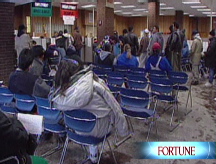
NEW YORK (CNNMoney.com) -- Unemployment is likely to continue to rise as companies cut more jobs, according to a new index from a respected business research group released Monday.
The Conference Board's Employment Trends Index (ETI) uses eight widely followed readings on employment and economic activity from both government and industry sources.
The Conference Board said the decline in the index's May reading suggests that the labor market hasn't yet hit bottom. The organization has computed the index readings back 35 years and found that it accurately predicts all turns in the labor market accurately during that period.
It said combining those eight factors gives a far more accurate reading on the employment outlook than looking at any of them alone.
"We forecast further softening in the labor market, a moderate rise in unemployment, and weaker wage growth over the next several quarters," said Gad Levanon, senior economist at The Conference Board. "Employers will find it easier to recruit and hire, and will be looking at slower growth in compensation costs. Workers will find it harder to get a job, a raise or a bonus - all of which will further rein in consumer spending."
The index turned lower in July 2007, signaling the loss of jobs and the rise in unemployment that has shown up in Labor Department readings so far this year.
The index has fallen by 6% from its peak in July, with a 0.5% decline between April and May. The last time the peak was as low as the April reading was December 2004.
The Conference Board plans to release this new index the Monday after the government's latest employment report. On Friday, the Labor Department reported the fifth straight month of job losses, with employers trimming 49,000 jobs from payrolls in May. The unemployment rate posted its largest jump in 22 years, rising to 5.5% from 5% in April.
Conference Board economists said the 5.5% unemployment rate may be overstating unemployment in the current economy due to the influx of teenagers into the work force who have not been able to find jobs.
They said the unemployment rate could decline later in the summer, even if the economy continues to lose jobs, as teenagers become discouraged and stop looking for a summer job.
But they said the ETI would have to show two to three months of gains, including positive readings for multiple components, before the index would predict a rebound for the labor market.
The index crept up slightly in January, but that was due to a gain in only one component, the National Federation of Independent Business' job opening index, which shows hiring by small businesses.
Levanon said that since the ETI has signaled every pickup in payrolls in the past 35 years -- usually about three months before the actual increase in jobs -- he believes job losses will continue for at least the next quarter or two.
And even after there are gains to the nation's payrolls, the unemployment rate typically continues to rise as discouraged job seekers who had stopped looking for work return to the labor force.
Keith Hembre, chief economist of First American Funds, said that given other indicators he tracks to make employment forecasts, including corporate profit and business confidence, he agrees that employment isn't due for any near-term rebound.
"What the Conference Board index is suggesting is pretty much in line with my thinking," he said.
Hembre expects more payroll losses of about 50,000 to 60,000 jobs a month through the second half of the year. And he thinks the unemployment rate is likely to reach 6% sometime in early 2009. 



