
Breakfast with cheetahs
A small U.S. tour business sends animal lovers into the bush to help threatened species.





OKONJIMA, NAMIBIA (Fortune Small Business) -- The vintage bush plane banks sharply to starboard, allowing me a bird's-eye view of a giraffe trotting along the red-orange Namibian desert floor.
The exhilaration of seeing my first big game overrides my wooziness. I forget that I'm buckled into the back seat of a broiling-hot 35-year-old single-engine aircraft. Dave Houghton, my pilot and tour guide, suddenly shouts over the roar of the motor: "Listen for the beeps, then scan the ground for cheetahs!"
Attached to each wing are small radio receivers, which he hopes will pick up reception from the dozens of wild cats wearing radio collars in the scrub some 500 feet below. Just as my stomach recovers from another steep turn, the beeps come louder, and the three-seat plane banks to port and descends. Houghton has found the crime scene.
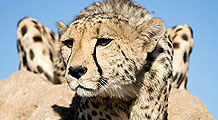
About 15 minutes later, after landing the plane and taking a short off-road ride in a Land Rover, we're standing five feet from something I've seen only on the National Geographic Channel: two cheetahs devouring a greater kudu, an African antelope. Black flies blanket a nearby tree. I hear cartilage from an ear ripping and then something else, very faint. One of the big cats is purring between bites.
"Hey!" says Houghton, noticing my stance a few feet away from the rest of the group. He gestures toward the antelope's bloated body decaying in the 90-degree heat. "You might want to reconsider standing downwind."
I stand my ground. I'm no glutton for gore, but I figure that enduring the stench of a day-old carcass must be an essential part of tracking radio-collared cheetahs, the first activity outlined in my Classic Africa itinerary. I catch a whiff of what smells like rotten wet dog food and spend the next ten minutes until we leave breathing through my mouth.
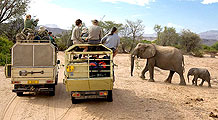
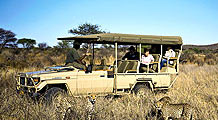
For ten days I'll be touring wildlife camps in Namibia and Botswana, accompanying researchers as they gather data on big cats, black rhinos, and elephants. Ecotourism - trips where travelers help preserve the communities they visit - is the fastest-growing segment of the tourism industry. A growing number of small U.S. travel firms have found their niche creating trips that combine some element of giving back with comfortable accommodations that don't stress the environment.
One company is Classic Africa, which arranges small group trips to wildlife camps in Botswana, Namibia, South Africa, Zambia, and Zimbabwe. The firm was founded by Margaret and Pierre Faber, who provide custom trips for about 500 clients a year, some 15% of whom are small-business owners. Pierre, 36, a native South African who spent his childhood tracking animals in the bush outside Johannesburg, says many of his clients are asking for trips to places such as Namibia, where many safaris focus on more than just big-game viewing.
"Most of these clients have already fallen in love with Africa and want to explore it in greater depth," says Pierre. "They're more involved than the average traveler and want exposure to things that aren't widely seen."
I fly from Johannesburg to Okonjima, a 10,000-acre family-run cheetah refuge an hour north of Windhoek, the Namibian capital. With fewer than 5,000 miles of paved roads covering Namibia's 318,000 square miles, the best way to travel between wildlife parks is via Sefofane Airways, a fleet of Cessna 210s flown by young, acne-peppered Afrikaner pilots.
As we touch down on Okonjima's dirt runway, three cheetahs - separated from the airstrip by a chainlink fence - break into a run alongside us, matching the plane's pace as it slows to a taxi.
"Their first instinct is to chase whatever they see moving," says Dean, an Okonjima tour guide who greets us after we land.
About 90% of Namibia's big cats live near commercial farmland. Okonjima's owners are trying to ease the rocky relationship between cats and ranchers, who often shoot cheetahs and leopards that prey on livestock. If a farmer spots a cat on his property, he can call the camp, which will send over a cat catcher. Okonjima, which uses more than 5% of the proceeds from guests to fund its animal rehab program, has rescued 900 cats since 2003.
I visit Okonjima's cat hospital - called AfriCat - on my second day. Two squat, one-room buildings flank an outdoor pen filled with warthogs. The examining room reminds me of my vet's office in Manhattan - the only difference is the gargantuan size of the exam table, which AfriCat staffers have used for leopards, lion cubs, and wild dogs.


-
 The Cheesecake Factory created smaller portions to survive the downturn. Play
 -
 A breeder of award-winning marijuana seeds is following the money and heading to the U.S. More
 -
 Most small businesses die within five years, but Amish businesses have a survival rate north of 90%. More
 -
 The 10 most popular franchise brands over the past decade -- and their failure rates. More
 -
 These firms are the last left in America making iconic products now in their twilight. More









 My dream is to launch my own business someday. Now that it's time to choose a major, I'm debating if I should major in entrepreneurial studies or major in engineering to acquire a set of skills first. Is majoring in entrepreneurship a good choice? More

 When it comes to in-flight pampering, the amenity kits offered by these 10 airlines are the ultimate in luxury More
 From a text therapy platform to apps that push you reminders to breathe, these self-care startups offer help on a daily basis or in times of need. More
 From Uber's flying cars to the Hyperloop, these are some of the neatest transportation concepts in the works today. More
 More Small Business


