How plan protects taxpayers
One expert gives Treasury a good grade. A bond guru even says the government could make money.



| Special Report |
 |
NEW YORK (CNNMoney.com) -- Make no mistake. It's hardly delightful for taxpayers that the Treasury had to step in to rescue Fannie Mae and Freddie Mac - the engines of the mortgage market.
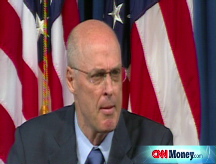
But one expert gave Treasury Secretary Henry Paulson and his colleagues high marks for devising a plan that gives first priority to taxpayers and minimizes their potential cost.
"I thought this was a very elegant approach," said attorney Thomas Stanton, author of two books on Fannie and Freddie and a lecturer at Johns Hopkins University. When it comes to who gets paid first and who gets hit last, he said, "taxpayers are going to be above preferred shareholders. The Treasury has really worried about protecting taxpayers."
Given the alternative - letting Fannie and Freddie flounder and fail (and the housing market along with them), taxpayers have some reason to feel good about the plan.
Indeed, protection of the taxpayer "is clearly one of the driving motivations in what the Treasury did," said Brian Gardner, a political analyst with Keefe, Bruyette and Woods.
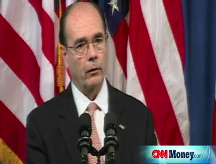
There are a few ways that Treasury could make taxpayer money available to Fannie and Freddie, according to the plan announced on Sunday by Paulson and James Lockhart, director of the Federal Housing Finance Agency.
Key among them is an agreement to back the debt of each GSE up to $100 billion to ensure they maintain a positive net worth. Doing so could assure Fannie and Freddie debt and mortgage-backed securities holders - including foreign central banks - that they'll always get paid, Stanton said.
In exchange for that backing, the GSEs will give the Treasury $1 billion in preferred stock. That preferred stock would pay quarterly dividends and fees. In addition, the GSEs would give the Treasury rights to buy 79.9% of the companies' common stock.
The government also will buy the agencies' mortgage-backed securities, which are income-producing assets. In recent months, they have carried higher yields to satisfy buyers who wanted more reward for the risk they were taking on.
The fact that Treasury would step into the market could encourage others to get back in, and that could have the effect of boosting prices for the agencies' securities. That, in turn, can help keep mortgage rates lower for homebuyers because there will be more credit in the market for mortgage bankers to draw on and use to make loans.
Lastly, the Treasury will, as needed, make loans to Fannie (FNM, Fortune 500) and Freddie (FRE, Fortune 500) lasting no more than a month. All loans would have to be backed by collateral and the Treasury reserves the right to set the interest rate with the goal of protecting the taxpayer.
So how much will the government spend and how much might taxpayers lose - or even make? All good questions without answers yet.
Everything, ultimately, depends on how the housing market fares, and the extent of the losses Fannie and Freddie sustain. But to hear one major market player tell it, there is some chance taxpayers could actually make back some money.
In an interview with CNNMoney.com, bond fund manager Bill Gross, co-investment chief of Pimco, said he believes in the next week "the bond market - certainly the agency mortgage market - will scream upwards in price and substantially lower in yield" in what he said could be the most dramatic move in the history of the mortgage market.
And part of the bailout might turn out to be a good investment for Treasury, since the government could get a good return on its preferred stock and will be buying mortgage securities at a relatively low price.
Said Gross, "I think the plan will likely make a profit for the taxpayer."