
Bailouts - The new rate cuts
The Fed held interest rates steady. A few hours later it tossed an $85 billion lifeline to AIG. Can this possibly save Wall Street?




NEW YORK (CNNMoney.com) -- The Federal Reserve, we are often told, has a dual mandate: to promote stable prices and maximum employment.
Well, it looks like the Fed now has a third mandate that trumps the other two: putting out the fires raging on Wall Street.
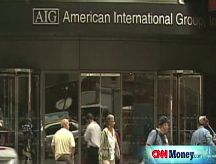
The central bank's $85 billion bridge loan to insurance giant AIG (AIG, Fortune 500) last night is an unprecedented (we've been using that word a lot lately) move to try to prevent the firm from meeting the same fate of the now bankrupt investment bank Lehman Brothers (LEH, Fortune 500).
The AIG bailout came just a few hours after the Fed's policy-rating committee decided to leave its key interest rate at 2% and said that it did not think a rate cut was necessary to stimulate the economy at this time despite the fact that "strains in financial markets have increased significantly." (Now that's the understatement of the millennium!)
Tellingly, New York Fed President Timothy Geithner - who is also Fed vice chairman - did not attend the meeting as apparently he and Treasury Secretary Henry Paulson were busy trying to hammer out the AIG rescue.
So what the Fed is saying is that it realizes that further rate cuts would do more harm than good since rates are already at a relatively low 2%. I applaud them for holding rates steady (and many readers agree, it seems) since more rate cuts would have just hurt savers and also possibly stoke new inflation fears.
Instead, the Fed is signaling that the only way out of this credit crisis is by making sure that the most important financial companies do not collapse. And not every financial company is going to be deemed important enough to save: exhibit A is Lehman.
But will the loan to AIG work?
The market seems skeptical. Tuesday afternoon's post-pause rally has been more than completely wiped out, with the Dow falling more than 300 points late Wednesday morning. The Fed giveth and the Fed taketh away.
Now, the government is spinning this as not a bailout per se because they hope to get the money back with substantial interest. In fact, they are charging AIG a loan shark-esque premium of the 3-month Libor rate plus 8.5%. That works out to about 11.4% based on today's rates.
Of course, the government is saving AIG at a difficult time. But this "bailout" may be different from the Fed's bailouts of Bear Stearns in March and the Treasury's takeover of Fannie Mae (FNM, Fortune 500) and Freddie Mac (FRE, Fortune 500) last week. The key difference: the Fed may actually be able to sell off parts of AIG at a decent price.
"To me a bailout is giving somebody cash and forgiving all responsibility for their debts. That's not happening here," said David Resler, chief economist with Nomura Securities International. "If AIG is solvent, but simply illiquid, this will allow for a sale of the company's assets over time without worrying about the pressure of the moment."
Clearly, the fact that the government is giving AIG two years to pay back the loan is a sign that it wanted to avoid a scenario where AIG was liquidated at the bargain basement prices ala Bear Stearns, Lehman and, arguably, even Merrill Lynch (MER, Fortune 500).
(Merrill may have agreed to be bought for $50 billion, but at $29 a share, that's still nearly a 70% discount to where the stock traded a year ago. Plus, Merrill is currently trading at just $21 a share, which reflects some investor doubts about Bank of America's (BAC, Fortune 500) ability to pull off the deal.)
It is highly unlikely that $85 billion will be able to keep AIG in its current form. The government is obviously betting that the various parts of the company can be sold off over the next two years for a decent enough price so that the loan can be eventually repaid in full with the proceeds from these sales.
Seriously, do you really think the government is happy to now own 80% of AIG? I don't think that Henry Paulson or Fed chairman Ben Bernanke want to be the ones picking up the phone when you call with questions about that policy claim you just filed.
Instead, Paulson, once he's done removing the fireman's hat he's wearing, is going to have to put his investment banker hat back on - he was formerly chairman and CEO of Goldman Sachs (GS, Fortune 500) after all - and help the Fed break up AIG into pieces that private equity firms, other insurers and maybe even sovereign wealth funds will want to buy.
If the Fed pulls this off, it could wind up being looked back upon as a brilliant move that helped get the financial system eventually back on track.
But that's a monumentally big IF.
"This should prevent a fire sale of assets and help result in an orderly process for liquidation," said Kenneth Kim economist Stone & McCarthy Research Associates. "This could work out but that remains to be seen. The Fed is trying to restore confidence. But sentiment can turn on a dime."
Finally, even if this gambit does work out, how many more times will the Fed be forced to make a decision about who to save and who to let fail? Shares of Morgan Stanley and Goldman Sachs both plunged Wednesday.
Will the Fed throw them lifelines if they are needed or will the central bank let them also go the way of Lehman?
Vincent Boberski, market strategist with FTN Financial, suggested that if push came to shove, the Fed will draw the line at more big bailouts.
A collapse of AIG, with more than $1.1 trillion in assets and businesses that touch far more many consumers around the globe than the investment banks, had to be prevented, Boberski said.
That's a scary thought. But the Fed does have to draw a line somewhere.
"It seemed like the decision making here was based on the systemic risk that AIG posed for the entire financial system versus Lehman. In hindsight, it seems like the Fed may have overreacted with Bear Stearns," Boberski said.
"And as we see the stocks of other financials falling, we have to ask ourselves, 'Are they more similar to AIG or to Lehman?' Most would fall more to the Lehman side," Boberski added. 



