CNNMoney.com
Companies Economy International Corrections Pre-market Trading After-hours Trading Winners/Losers/Actives Bonds Currencies Commodities World Markets Money Magazine Real Estate Taxes Jobs Ask the Expert Money 101 Autos Mutual Funds The Help Desk Loan Center Best Places to Live Ask the Expert Ultimate Guide to Retirement Retirement Calculators Best Funds Best Places to Retire Fortune Brainstorm Tech Apple 2.0 Blog Big Tech Blog Sectors and Stocks Tech Talk Resource Guide Small Business Makeovers Questions & Answers Small Business Video 100 Best Places to Launch FSB 100 Fortune Small Business Fortune 500 Brainstorm Tech Investing Management C-Suite Rankings Main Create Portfolio Edit Portfolio Create Alerts Edit Alerts
SPECIAL REPORT

Rescue cost: Hundreds of billions

Washington unveils sweeping efforts to save financial system. Bottom line will depend on what Uncle Sam pays for toxic assets.

EMAIL  |   PRINT  |   SHARE  |   RSS
 
google my aol my msn my yahoo! netvibes
Paste this link into your favorite RSS desktop reader
See all CNNMoney.com RSS FEEDS (close)
By Jeanne Sahadi, CNNMoney.com senior writer

How would you rate the government's response this week to the credit crisis?
  • Appropriate
  • Not doing enough
  • Overreacting

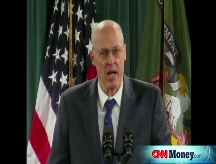
NEW YORK (CNNMoney.com) -- Treasury Secretary Henry Paulson on Friday didn't mince words when it came to the cost of his latest proposal to stem the credit crisis.

"We're talking hundreds of billions of dollars - this needs to be big enough to make a real difference and get at the heart of the problem," he said. "This is the way we stabilize the system."

Paulson, speaking at a brief press conference in Washington, offered few details on his plan to help banks offload their toxic mortgage assets. Treasury is drafting a legislative proposal for lawmakers to consider this weekend.

The speculation is that the Treasury will help banks clear their balance sheets of illiquid mortgage assets by buying them at a discount.

One way the plan could work is for the Treasury to make the purchases through a bidding process. Companies that want to offload their hard-to-sell assets from their balance sheets would bid to sell to the government at a huge discount. The company willing to sell at the lowest price wins.

The government would then be able to sell the assets back into the market when it wanted.

The idea is that the government would buy at below-market rates and sell for a gain when the housing market recovers.

"The government could make a profit, a substantial profit," said Jaret Seiberg, a financial services analyst at the Stanford Group, a policy research firm.

This optimistic scenario hinges not only on a housing recovery but on how big a discount the government gets when it buys banks' toxic mortgage assets to begin with.

The problem is that the assets have proven extremely difficult to value as the demand for them has disappeared.

"The pricing mechanism is going to be central," Seiberg said.

On Friday, Sen. Richard Shelby, R-Ala., the ranking member on the Senate Banking Committee, told CNNMoney.com that the latest plan from Treasury could cost up to $500 billion. Awaiting details on the plan from Treasury, Shelby said, "I think this is too big to just accept ... without understanding who pays."

If he's right about the $500 billion, the headline figure on the government's attempts to stem the credit crisis hits $1.3 trillion. That includes all the loans, investments and new programs committed by the Federal Reserve and Treasury this year.

But that doesn't mean that taxpayers would end up paying anything near that amount, because in exchange for its commitments the government will get saleable and income-producing assets.

If these efforts result in a net cost to the taxpayer, it's a better bet than the alternative, Paulson said.

"I am convinced that this bold approach will cost American families far less than the alternative - a continuing series of financial institution failures and frozen credit markets unable to fund economic expansion," he said. To top of page

Features
  • john_reh.04.jpg
    These workers fear that settling for a survival job could hurt them when hiring picks up again.  More
  • oil.ju.04.jpg
    $80 oil is a problem and could hurt recovery of a fragile consumer-led economy. More
  • 2009_mini_cooper.04.jpg
    The small carmaker will produce its own high-end version of the luxury icon. More
  • foodie_gifts.04.jpg
    Choose one of these culinary gift ideas for the kitchen lover in your life. More
  • mens_main.04.jpg
    Try these holiday offerings for the fashion-conscious man in your life. More
  • womens_gifts.04.jpg
    These presents will knock the socks off of any female fashion lover. More
  • kellogg_eggo_waffles_b.04.jpg
    Kellogg is rationing the waffles through mid-2010 due to flooding at an Atlanta bakery. More
Markets Last Change
Dow Jones 10,470.90 152.74 / 1.48%
Nasdaq 2,181.48 35.44 / 1.65%
S&P 500 1,109.69 18.31 / 1.68%
10-year Bond 99 27/32 Yield: 3.39%
U.S.Dollar 1 euro = $1.498 0.013
November 23, 2009 11:25 AM ET
CompanyPrice% Change
Blockbuster Inc 0.63 -14.59%
CIGNA Corp 32.20 7.21%
ArvinMeritor Inc 9.02 5.87%
Dillard Department Stores Inc 16.48 5.24%
Nov 23 11:23am ET †
More Galleries
Heroes of the Economy: Where are they now? In March, CNNMoney profiled people making personal sacrifices to help others during the recession. Did their efforts pay off? CNNMoney checks in. More
Women of power Shot during the Fortune Most Powerful Women Summit, these portraits showcase some of the world's most influential leaders. Photographs by Robyn Twomey. More
Best holiday gifts for the homebody These goodies for the home will delight any nester, and won't cost you a fortune. More

© 2009 Cable News Network. A Time Warner Company. All Rights Reserved. Terms under which this service is provided to you. Privacy Policy
Copyright © 2009 BigCharts.com Inc. All rights reserved. Please see our Terms of Use.
MarketWatch, the MarketWatch logo, and BigCharts are registered trademarks of MarketWatch, Inc.
Intraday data provided by Interactive Data Real-Time Services and subject to the Terms of Use.
Intraday data is at least 20-minutes delayed. All times are ET.
Historical, current end-of-day data, and splits data provided by Interactive Data Pricing and Reference Data.
Fundamental data provided by Morningstar, Inc..
SEC Filings data provided by Edgar Online Inc..
Earnings data provided by FactSet CallStreet, LLC.