
Rescue cost: Hundreds of billions
Washington unveils sweeping efforts to save financial system. Bottom line will depend on what Uncle Sam pays for toxic assets.



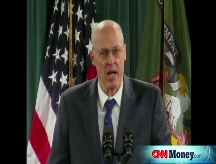


NEW YORK (CNNMoney.com) -- Treasury Secretary Henry Paulson on Friday didn't mince words when it came to the cost of his latest proposal to stem the credit crisis.
"We're talking hundreds of billions of dollars - this needs to be big enough to make a real difference and get at the heart of the problem," he said. "This is the way we stabilize the system."
Paulson, speaking at a brief press conference in Washington, offered few details on his plan to help banks offload their toxic mortgage assets. Treasury is drafting a legislative proposal for lawmakers to consider this weekend.
The speculation is that the Treasury will help banks clear their balance sheets of illiquid mortgage assets by buying them at a discount.
One way the plan could work is for the Treasury to make the purchases through a bidding process. Companies that want to offload their hard-to-sell assets from their balance sheets would bid to sell to the government at a huge discount. The company willing to sell at the lowest price wins.
The government would then be able to sell the assets back into the market when it wanted.
The idea is that the government would buy at below-market rates and sell for a gain when the housing market recovers.
"The government could make a profit, a substantial profit," said Jaret Seiberg, a financial services analyst at the Stanford Group, a policy research firm.
This optimistic scenario hinges not only on a housing recovery but on how big a discount the government gets when it buys banks' toxic mortgage assets to begin with.
The problem is that the assets have proven extremely difficult to value as the demand for them has disappeared.
"The pricing mechanism is going to be central," Seiberg said.
On Friday, Sen. Richard Shelby, R-Ala., the ranking member on the Senate Banking Committee, told CNNMoney.com that the latest plan from Treasury could cost up to $500 billion. Awaiting details on the plan from Treasury, Shelby said, "I think this is too big to just accept ... without understanding who pays."
If he's right about the $500 billion, the headline figure on the government's attempts to stem the credit crisis hits $1.3 trillion. That includes all the loans, investments and new programs committed by the Federal Reserve and Treasury this year.
But that doesn't mean that taxpayers would end up paying anything near that amount, because in exchange for its commitments the government will get saleable and income-producing assets.
If these efforts result in a net cost to the taxpayer, it's a better bet than the alternative, Paulson said.
"I am convinced that this bold approach will cost American families far less than the alternative - a continuing series of financial institution failures and frozen credit markets unable to fund economic expansion," he said. 



