
JPMorgan buys WaMu
In the biggest bank failure in history, JPMorgan Chase will acquire massive branch network and troubled assets from Washington Mutual for $1.9 billion.



NEW YORK (CNNMoney.com) -- JPMorgan Chase acquired the banking assets of Washington Mutual late Thursday after the troubled thrift was seized by federal regulators, marking the biggest bank failure in the nation's history and the latest stunning twist in the ongoing credit crisis.
Under the deal, JPMorgan Chase will acquire all the banking operations of WaMu, including $307 billion in assets and $188 billion in deposits.
To put the size of WaMu in context, its assets are equal to about two-thirds of the combined book value assets of all 747 failed thrifts that were sold off by the Resolution Trust Corp. - the former government body that handled the S&L crisis from 1989 through 1995.
In exchange for scooping up WaMu, JPMorgan Chase (JPM, Fortune 500) will pay approximately $1.9 billion to the Federal Deposit Insurance Corporation.
Separately, JPMorgan announced Thursday that it plans to raise $8 billion in additional capital through the sale of stock as part of the deal. The bank expanded the offering to $10 billion on Friday.
The acquisition is JPMorgan Chase's second major purchase this year following the mid-March acquisition of investment bank Bear Stearns, a deal that was also engineered by the government.
"We think it is a great thing for our company," JPMorgan Chase Chairman and CEO Jamie Dimon said in a conference call with investors late Thursday night.
As a result of the acquisition, the New York City-based JPMorgan Chase will now boast some 5,400 branches in 23 states.
Federal regulators, who helped shepherd the deal, stressed that the transition for WaMu customers would be "seamless."
"There will be no interruption in services and bank customers should expect business as usual come Friday morning," FDIC Chairman Sheila Bair said in a statement.
WaMu is the 13th bank to fail so far this year and earns the title of the nation's biggest bank failure by assets on record, ahead of Continental Illinois, which had about $40 billion in assets ($67.7 billion in 2008 dollars) when it failed in May of 1984.
The FDIC, however, was quick to point out Thursday evening that the WaMu-JPMorgan Chase deal would not have any impact to its insurance fund which covers customer deposits when banks fail.
"WaMu's balance sheet and the payment paid by JPMorgan Chase allowed a transaction in which neither the uninsured depositors nor the insurance fund absorbed any losses," Bair said.
The FDIC insures the assets held by 8,451 banking institutions with a total of $13.4 trillion.
WaMu had been one of the most hard-hit banks during the financial crisis after it bet big, like many of its competitors, on the strength of the U.S. housing market -- only to see its fortunes sour as housing prices fell.
Following several ratings agency downgrades this week and a freefall in the company's stock, many analysts were speculating that the endgame for the embattled savings and loan was imminent.
WaMu (WM, Fortune 500) shares were close to worthless Friday, falling 90% to just 16 cents a share. JPMorgan Chase shares gained more than 2.5% in midday trading.
In a press conference held late Thursday, Bair said regulators deemed it was necessary to act as the company had come under "severe" liquidity pressure. Regulators said that WaMu was experiencing a "run on the bank", as roughly 10% of WaMu deposits were pulled on Monday.
As a result, regulators saw the need to act this week, even as Congress and the White House continued to hash out a bank bailout plan.
Bair added that the company was on the FDIC's latest so-called "problem bank" list for the third quarter, which has yet to be published.
All told, Bair said four banks made bids for WaMu but JPMorgan Chase ultimately won out when the auction was held Wednesday. Several other large institutions, including Wells Fargo (WFC, Fortune 500), Citigroup (C, Fortune 500) and HSBC (HBC), were poring over the company's books, according to news reports last week.
JPMorgan Chase won because they were "the highest bid and the lowest cost resolution," Bair said.
"It was our cheapest option," she said.
Analysts were largely encouraged by the news even as JPMorgan Chase absorbs WaMu's toxic subprime and option-ARM mortgages as part of the deal.
"My initial impression is that this deal is 'generally OK'," wrote Nancy Bush, managing member at investment advisory firm NAB Research LLC, adding that there would be questions about whether the loan losses that JPMorgan took as part of the deal would be sufficient.
All told, JPMorgan Chase said it would recognize projected losses on the loan portfolio upfront by marking down the value of the loans by a whopping $31 billion.
Quite possibly the biggest losers in Thursday's deal, however, are WaMu's stock and debt holders, who were effectively wiped out.
Among that group was the private equity giant TPG, which was part of a consortium of investors that acquired a stake in WaMu for $7 billion in April.
JPMorgan's Dimon said in a conference call with reporters Friday morning that his firm was in talks to buy WaMu earlier this year but that JPMorgan never made a formal offer.
When pressed about what might be next for JPMorgan following two massive deals this year, Dimon didn't close the door altogether on acquiring another commercial bank.
"This is still a big country and there are a lot of places we are not in," he said.
But he and other executives offered little insight about what would happen to WaMu personnel.
Neither Dimon nor Charlie Scharf, JPMorgan's head of retail financial services, were able to provide any estimate as to how many workers could lose jobs as a result of the deal or whether top execs at WaMu, including recently installed CEO Alan Fishman, would remain with the combined firm.
"It's just too early to know right now," said Scharf.
The fall of WaMu is the latest turn in a dizzying two weeks that have seen the bankruptcy of Lehman Brothers, the acquisition of Merrill Lynch by Bank of America (BAC, Fortune 500) and the near collapse of insurance giant AIG (AIG, Fortune 500).
The widening credit crisis has prompted President Bush to seek from Congress extraordinary authority to spend as much a $700 billion to bail out the nation's financial system by purchasing toxic assets from banks.
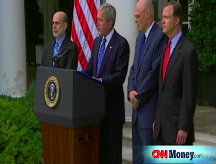
President Bush, in a televised address Friday morning, said the nation's economy is at risk, adding he believed that Congress will move quickly on a bailout proposal.
"We've got a big problem," he said.
Regulators acknowledged they were encouraged to get a deal done but Dimon stressed to investors that a potential bailout by the government was not a factor. 



