
Banks: Only the strong survive
More failures seem likely as collapse of WaMu continues to shake investor and consumer sentiment. Willing buyers remain few and far between.



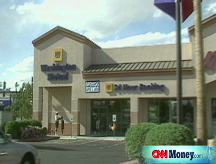
NEW YORK (CNNMoney.com) -- Banks have been thrust into the center of a financial tempest during the past few months that has left industry experts and consumers wondering: what's next?
Well, if Thursday's collapse of Washington Mutual and subsequent sale to JPMorgan Chase (JPM, Fortune 500) revealed anything, it's that no bank is too big to fail and the strongest banks are likely to get stronger by acquiring weaker banks.
So far this year, 13 institutions have failed, including Washington Mutual (WM, Fortune 500), which ranks as the biggest ever in U.S. history. But both analysts and industry regulators have warned that number will grow with the economy weakening and the housing market continuing to spiral lower.
While bank failures are considered a natural part of doing business even in good times, a general state of panic about the industry has complicated matters as investors are actively betting on which might be the next bank to fail.
Shares of regional bank giants Wachovia (WB, Fortune 500) and the Cleveland-based National City (NCC, Fortune 500) each lost more than a quarter of their value Friday on speculation that either firm could be in serious trouble.
Both companies have lost money in the first two quarters of this year and are expected to report losses for all of 2008 due to exposure to bad mortgages.
A representative from National City condemned the comparison to WaMu while Wachovia stressed "its strong retail franchise and large and stable deposit base" in a statement.
But later Friday, The New York Times reported that Wachovia and Citigroup (C, Fortune 500) were in early talks about a merger. Spokespeople for Citigroup and Wachovia had no comment about the report.
In addition, The Wall Street Journal reported that Wachovia is talking to Wells Fargo and Spanish bank Banco Santander as well as Citigroup.
The big concern for struggling banks is that market jitters, in addition to driving down the stock price, can also fan fears among bank customers.
As a result, some banks will have to worry about a so-called "run" on the institution, where customers pull out their money. For example, WaMu had 10% of its deposits pulled out this past Monday, according to bank regulators.
"One must now worry about old-fashioned bank runs, which is something that was supposed to have disappeared after the Great Depression," said Jaret Seiberg, a financial services analyst at the Stanford Group in Washington.
Kevin St. Pierre, who covers National City for Sanford Bernstein, argued in a research note Friday that National City is not "the next WaMu" and that there has been no evidence of customers pulling money out of that bank.
"[National City] is much better capitalized, better reserved, less exposed to residential real estate," he wrote. "[National City] has shown no signs whatsoever of a flight in deposits."
Whether other banks the size of WaMu fail remains to be seen. Analysts said many institutions of all sizes could be saved if Congress manages to cobble together a bailout plan that would remove the troubled assets from the books of banks across the country.
As of Friday afternoon, lawmakers were trying to work past political divisions in the hopes of crafting legislation that would address the crisis.
Until then, there are few lifelines for the battered banking sector other than the possibility of more mergers.
The Federal Reserve took steps earlier this week to encourage bigger private investments in banks by loosening long-standing rules that limited how much of a stake buyout firms or other outside investors could take in a bank.
But other than Warren Buffett's $5 billion investment in Goldman Sachs (GS, Fortune 500) earlier this week, few distressed investors have stepped into the fray out of fear of seeing their investment wiped out altogether.
Certainly consolidation could be the answer at a time when many bank stocks are dirt cheap. But with few exceptions, banks are shying away from mergers since they are fearful of acquiring another company's troubled assets.
What's more, there are few "white knights" or banks stable enough and with enough cash on hand to start gobbling up their peers.
"Who is really left that is of any consequence in this environment?" asked John Jay, a senior analyst at the Aite Group, a research and advisory firm focused on the financial services industry.
JPMorgan Chase has emerged as arguably the strongest big bank in the wake of the crisis but it also bought Bear Stearns earlier this year and may not be able or willing to try and deal with three big merger integrations at once.
Bank of America will also have plenty to digest following its most recent acquisitions, including the purchase of Merrill Lynch (MER, Fortune 500) just two weeks ago and mortgage lender Countrywide Financial earlier this year.
Wells Fargo (WFC, Fortune 500), which has a dominating presence along the West Coast and the Minneapolis-based US Bancorp (USB, Fortune 500) also seem healthy enough to scoop up a rival. But analysts are divided about whether either company really is willing or able to make a big acquisition.
Foreign banks, such as the British giant HSBC (HBC) and Banco Santander (STD), were both mentioned as possible suitors for WaMu before it went belly up. But it is not clear just how committed either firm is to further expansion in the U.S.
HSBC already owns more than 400 bank branches in the U.S., mostly in New York. Santander owns a minority stake in the Philadelphia-based savings and loan Sovereign Bancorp.
And the collapse of WaMu, combined with the piecemeal sale of parts of Lehman Brothers after it filed for bankruptcy, show that healthier banks are waiting for their rivals to go under first.
That way, they can buy up their assets for just pennies on the dollar. JPMorgan Chase paid just $1.9 billion to federal regulators for the banking assets of WaMu.
"That seems to be the new game plan here," said Gregory Church, chief executive of Church Capital Management in Philadelphia, which owns shares of Bank of America. "These guys are seeing the light in a different way." 



