
Hopes grow for emergency rate cut
Some economists think the Federal Reserve will try to boost battered confidence in banks and the economy by cutting rates again in the next few days.




NEW YORK (CNNMoney.com) -- The Federal Reserve could be prompted to make an emergency interest rate cut in the next few days in an attempt to boost confidence in the battered banking sector.
The central bank could even move as soon as Tuesday to cut its fed funds rate, a key overnight lending rate, by at least a quarter percentage point, according to interest rate futures for September listed on the Chicago Board of Trade.
The Fed's next scheduled meeting to discuss interest rates is a two-day session that ends on October 29.
Even though some think an emergency rate cut may have only a limited impact on the economy, it may be necessary to boost investor and consumer confidence.
"What makes it so urgent and crucial is the psychological lift it would provide," said Bernard Baumohl, executive director of the Economic Outlook Group, a Princeton, N.J. research firm. "At this point in time there's a crisis of confidence in the financial sector and on Main Street."
Still, many say the main problem facing the economy the last few weeks is not that it's expensive to get a loan but that banks are growing increasingly unwilling to extend credit.
In just the past three weeks, the federal government seized control of troubled mortgage finance firms Fannie Mae (FNM, Fortune 500) and Freddie Mac (FRE, Fortune 500), Lehman Brothers filed for bankruptcy and Merrill Lynch (MER, Fortune 500) was forced to sell itself to Bank of America (BAC, Fortune 500).
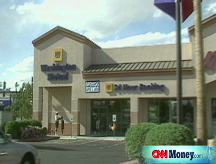
There also was a government bailout of insurance giant American International Group (AIG, Fortune 500) and the failure of Washington Mutual (WM, Fortune 500), the nation's largest savings and loan Thursday night.
That tsunami of bad news left banks and Wall Street firms hoarding their cash due to fears of what's next, analysts said.
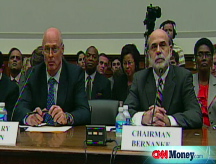
Because of this problem, Fed Chairman Ben Bernanke and Treasury Secretary Henry Paulson have been pushing for a $700 billion bailout of Wall Street, a plan that would have the government buy mortgage-backed securities now dragging down the balance sheets and earnings of financial firms.
Congressional negotiators were trying to reach an agreement on the controversial plan Friday and proponents hope a deal could be announced this weekend.
With that in mind, some say the Fed may announce an emergency rate cut at the same time a bailout deal is announced.
"I think Bernanke would have done it by now if he wasn't trying to keep the pressure on Congress," said Kevin Giddis, managing director and head of research at Morgan Keegan. "I think the Fed will feel compelled to put a big glob of ice cream on top of the bailout cake. And I think piling on is the right thing to do right now."
The Fed last made an emergency cut when it lowered rates by three-quarters of a percentage point on January 21 in response to financial market turmoil. It cut rates again by a half-point cut at its regularly-scheduled Jan. 30 meeting.
The central bank cut rates again in March and April and has left rates unchanged at 2% at its last three meetings.
On the day of the Fed's last meeting on Sept. 16, investors were actually predicting a cut then. But the central bank chose to leave rates alone, citing continued concerns about inflation as well as the volatile financial markets.
Higher interest rates tend to add to inflation pressures. For this reason, some Fed watchers say the Fed will try to hold off making any rate moves until at least the next meeting in order to see if credit markets can start functioning again without an additional cut.
After all, a rate cut isn't without risks. It could cause the dollar to lose value, which in turn could spark a new rally in oil prices.
"I would doubt [the Fed] will make an emergency cut, although I wouldn't rule it out," said Lyle Gramley, a former Fed governor now with The Stanford Group. "A cut is not going to make credit more available. Unless the markets begin to function more normally, it won't do much good for the Fed to lower rates anyway."
Gramley adds that there are some members of the Fed's rate-setting committee who strongly opposed the rate cuts earlier this year.
Dallas Fed President Richard Fisher, who was against most of the rate cuts and actually voted for a rate hike at the June and August meetings, said in speech Thursday that low interest rates at the start of the decade are at least partly responsible for the problems now facing Wall Street.
The Fed cut rates to 1% in June 2003 and it held them at level for a year, which helped feed the loose mortgage lending practices and housing bubble that are generally seen as the cause of the current crisis, Fisher said.
"In my book, rates held too low, too long during the previous Fed regime were an accomplice to that reckless behavior," he said.
Fisher also cites the risks of inflation, even if oil and gasoline prices have retreated from their highs of earlier this year. But many economists argue that with the slowdown spreading across the globe, there will be little inflation pressure going forward and little downside for the Fed to cut rates.
Some say the dollar could even rally after a rate cut since it may restore faith in the financial sector among global investors. Rate cuts could also help to improve earnings for many battered banks.
So if the Fed is seriously considering a rate cut as a way to respond to the current crisis, there's no point in holding off until its next meeting, which is more than a month away.
"I don't see them waiting until [October] 29th if they're going to do something," said John Silvia, chief economist for Wachovia. "What the hell are you going to keep the powder dry for?" 



