
Fed pumps billions more into banks
Central bank doubles to $300 billion the amount it will loan banks. Loans could reach $900 billion by end of year.



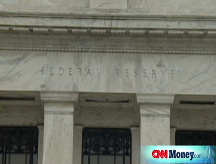
NEW YORK (CNNMoney.com) -- The Federal Reserve announced Monday that it will increase by hundreds of billions of dollars the money it makes available to the nation's banks.
The central bank said that its so-called term auction facility, which accepts financial instruments such as mortgage-backed securities as collateral, will be doubled immediately to $300 billion. The total amount available to banks will rise to $600 billion under the moves announced Monday.
In addition, the Fed signaled it could increase the amount available through those loans to $900 billion by the end of the year, increasing the amount the Fed will loan through the program by $750 billion above its previous limit.
The moves come in the wake of the passage on Friday of a $700 billion bailout bill that will allow Treasury to buy damaged assets directly from banks and Wall Street firms.
Experts said the moves by the Fed were an acknowledgement that many of the nation's leading financial institutions may not be able to wait until Treasury sets up its program. It may take weeks or perhaps even months before the Treasury can pump billions into the system itself by buying the damaged assets held on their balance sheets.
"The crisis in credit markets has become very acute, not just here but in Europe as well," said Lyle Gramley, a former Fed governor who is now an economist with the Stanford Group. "In a situation like this, you have to provide all the liquidity that is needed so that illiquid institutions don't become insolvent institutions."
The rapid expansion of the Fed program is essentially like an emergency bridge loan for institutions caught in a credit squeeze, said Kevin Giddis, head of fixed-income sales trading and research for investment firm Morgan Keegan.
The Fed had little choice but to try to pump as much cash as possible into the system, no matter the risks associated with taking damaged assets as collateral, Giddis said.
"Liquidity is needed immediately, and we're talking hours," he said. "I think the Fed will continue to take whatever steps it can until we unlock the problem."
Giddis and Gramley both agree that the Fed appears to be focused on these kinds of non-traditional measures to pump cash into the market rather than simply cutting interest rates, which is how the central bank has historically spurred a slowing economy. But neither would rule out the possibility that the Fed will do an emergency rate cut before its Oct. 28 and 29 meeting if problems in credit markets continue to worsen.
The term auction facility was announced in December as a move to pump cash into the already battered credit markets. The Fed allows banks to bid in an auction for the rate they're willing to pay to borrow the funds, and it accepts a much wider range of collateral for the loans than in other forms of lending by the central bank.
The Fed started loaning $20 billion in its first auction in December, but it quickly reached a $150 billion limit by late May and has stayed at or near that level since then.
The auctions are split between different length loans. The Fed's statement Monday said it is doubling both its 28-day and 84-day auctions to $150 billion each immediately. The Fed conducted a previously scheduled 84-day auction Monday morning for $150 billion of funds. That was originally set to be a $75 billion auction before Monday's announcement.
The Fed also announced it would pay banks interest on their reserve holdings. That change had been set to start in 2011, but its effective date was moved up as part of the bailout legislation enacted on Friday.
Paying interest will allow the central bank to have control over the fed funds rate, its key overnight lending rate target.
The Fed announces its fed funds rate target after every meeting of its policymakers. But in fact the rate is movable: The central bank must buy and sell treasuries to maintain it close to the target.
It potentially could be hard for the Fed to keep the funds rate close to its target as the central bank takes on so many troubled financial assets as collateral - rather than holding treasuries. By agreeing to pay interest equal to the fed funds, there is little chance that the fed funds rate will fall below the target because banks will have no incentive to loan money for less.
An official familiar with the Fed move said Monday that the central bank couldn't have substantially increased the money available through the auction until it received the congressional authority to pay interest.
He said that while it may appear that the Fed move negates the need for the Treasury-led bailout, in fact it provides only short-term benefit to the institutions.
"This treats the symptoms of the problems," said the official, who spoke on condition that his name not be used. "Treasury is the one trying to cut out the cancer."
The crisis in financial markets was spreading around the globe, sending overseas stocks sharply lower Monday while U.S. stock futures also fell.
Over the weekend, European governments moved to shore up some leading financial institutions there, including a $69 billion bailout for Hypo Real Estate AG, and the purchase of the Belgian and Luxembourg operations of Fortis NV by French banking giant BNP Paribas, in a deal announced by the Belgian government. And speculation grew that governments in Europe may soon announce their own bailout package. 



