
Oil recovers but demand worries remain
Crude prices end their losing streak after Europe, the UK, and U.S. move to pump billions into financial institutions. But experts warn the worst may not be over.




NEW YORK (CNNMoney.com) -- Oil prices bounced back above $80 a barrel Monday after a group of European countries tried to restore economic confidence by promising to bail out major banks.
The sliding global economy pulled oil prices to a 13-month low on Friday as investors worried that cash-strapped businesses and consumers were cutting back on fuel consumption.
U.S. crude for November delivery settled up $3.49 to $81.19 a barrel in New York on Monday, following a pledge by euro-zone nations to provide capital and guarantee loans.
The Treasury Department also began laying out plans Monday to implement the government's $700 billion program to restore bank confidence and get money flowing through the economy again. The plan was signed into law 10 days ago.
There were also pledges by 15 Eurozone nations and the U.K. to stabilize their respective banking systems.
Demand problems: However, even if the efforts of the world's governments succeed in shoring up the global financial system, it may not restore demand right away, according to Rachel Ziemba, energy analyst at RGE Monitor.
Monday's rebound "may be a lull before the storm," said Ziemba. "Even if we have the stabilization of the financial markets and get the interbank markets flowing again, we're still likely in a global recession," she said.
"Chances are more than 50/50 that the world will see a global slowdown of some sort," added Chris Lafakis, associate economist with Moody's Economy.com.
Government efforts may contain the financial fallout, but demand for oil will probably continue to decline - just not as much, according Lafakis.
Demand for crude has tumbled as businesses and consumers in the United States, the world's largest oil user, began to cut back. Energy spending is often one of the first areas to see cuts when money is tight, according to analysts.
A government inventory report last week said that demand for gasoline had fallen by 5.3% over the four weeks ended Oct. 3, compared to a year earlier.
Goldman lowers forecast: The decline in demand prompted Goldman Sachs to cut its oil price forecast for 2008 to $70 from $115 a barrel. The bank also slashed its forecast for 2009 year-end prices to $86 from $123 a barrel.
"We clearly underestimated the depth and duration of the global financial crisis and its implications on economic growth and commodity demand," wrote Jeffrey Currie, senior energy economist at Goldman Sachs in a research note.
Falling demand was one of the factors in oil's fall from a record high of $147.27 a barrel in mid-July.
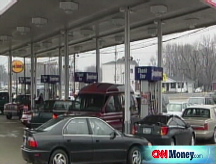
Gasoline: Retail gasoline prices have also followed suit, falling more than 4 cents to a national average of $3.206 a gallon from Sunday according to a daily survey by motorist group AAA.
Falling crude prices have sent gasoline down from a record average of $4.114 a gallon in July, and some experts have speculated that it could soon swing below $3 a gallon. 



