
Internet video finally pays off
A medical-translation company figures out how to make online video pay - after a decade of trying different systems.



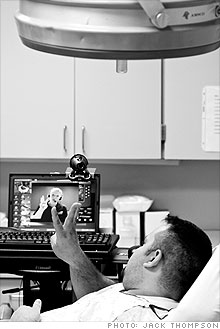 |
| Telemedicine in effect at Southwest General, San Antonio |
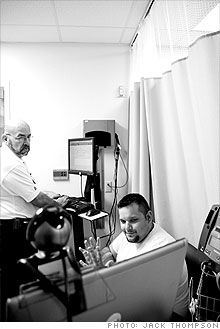 |
| A doctor at the translation terminal |

(Fortune Small Business) -- The first time Simon Gongora saw a videoconference over the Internet, he was hooked. He was running a business that hired out medical translators to hospitals so that non-English-speaking patients could converse with doctors. With Internet video, he realized, his translators could work remotely with a far wider range of hospitals - giving him an edge over competitors.
"I knew it would be the future of this business," says Gongora, now 55. "I just had no idea it would take this long to pay."
Gongora and his wife, Diana, founded Language Assistance Telemedicine in 1999 - and spent the better part of a decade trying to find online video technology that worked. Their story is a profile in persistence. The Houston-based company tried two ineffective tech solutions before coming up with the right combination of hardware and software last year. Its 2008 revenue is projected to rise 25% - no mean feat in a downturn.
Language Assistance Telemedicine operates some 75 remote translation stations in hospitals and clinics across the U.S., each equipped with a phone, camera, and computer monitor. The stations let hospitals connect to 12 interpreters based out of Language Assistance's office at the Texas Medical Center in Houston (with freelancers, the staff can swell to 50).
The doctor speaks into the phone, and the patient sees and hears the interpreter on the screen. The company's interpreters can translate complex medical terms into 143 languages. The idea seemed simple - and potentially lucrative, considering the cultural and linguistic diversity of U.S. hospital patients. But putting it into practice was anything but easy.
For the first three years of the company's existence, the Gongoras ran Polycom's ViaVideo system on Microsoft (MSFT, Fortune 500) Windows PCs that they configured and sold themselves. In 2002 they switched to spiffy Apple (AAPL, Fortune 500) iMacs and used Apple's bundled iChat software for the translation calls. But neither setup sold well. The ViaVideo system (since discontinued) was too complicated for most users. Apple's software was relatively easy to use, but hospital IT departments were wary of supporting Macs.
Both systems were also prohibitively expensive for many hospitals. The Gongoras charged $2,600 for each workstation, a modest 30% more than their cost. The real revenue came from translator fees, which averaged $2 a minute. But the only way to grow that revenue was to sell more workstations - and in six years the Gongoras sold fewer than 40 units.
"These were nice systems," says Diana Gongora. "But they were really tough to make money from."
Luckily, many companies now serve the online videoconference market: Cisco (CSCO, Fortune 500), Teliris, HP (HPQ, Fortune 500), and Telanetix compete with Polycom (PLCM) and Apple. In 2004 Simon Gongora saw ads for Unified Video Advantage, a new technology from Internet hardware giant Cisco Systems. It turned out to be a much cheaper and more flexible solution.
For starters, the system works on PCs that hospitals already have. Language Assistance Telemedicine simply resells a Cisco "soft-phone," which makes calls over the Internet, and a Web camera. When hospitals call Language Assistance, video shows up automatically on the computer screen.
The application was easy enough for health workers with little IT experience to operate. Better yet, the price was right. Language Assistance Telemedicine now charges hospitals around $1,000 for each setup, less than half the previous price - but thanks to cheaper Cisco equipment, the Gongoras tend to enjoy a 300% markup on each sale, a tenfold increase. Hospitals are showing more interest, and the company recently announced its largest order to date: 16 translation systems sold to IASIS Health Care in Franklin, Tenn.
The Gongoras expect revenue to rise from $1 million in 2007 to $1.25 million in 2008. They have also started selling online videoconference systems that doctors can use to diagnose patients remotely.
Cisco's video services were far from a slam dunk for the Gongoras to install and sell. Most hospitals forbid cold-calling, so the Gongoras had to resort to face-to-face pitching.
"We do a lot of expensive trade shows," says Diana Gongora. Then there's customer service, which the company provides for free (it is considered part of the built-in cost of doing business with hospitals). So a problem with a hospital's Internet connection, say, can quickly eat up profits.
Still, the system pays off - as it could for just about any business that needs to see a client from afar, such as personal banking or manufacturing.
"Customers should do a full network assessment before installing video," says Mike Fratesi, a Cisco manager. "But there is no reason why a well-managed small business cannot make these systems work for them" - just as the Gongoras have. 
Puree a rake for fun and profit: How one manufacturer drove sales up 500% - by putting its CEO on YouTube.
Being Big Brother: Installing surveillance cameras to keep an eye on the staff can help business owners boost profits and pinpoint problems.
Happy customers - and no service staff

-
 The Cheesecake Factory created smaller portions to survive the downturn. Play
 -
 A breeder of award-winning marijuana seeds is following the money and heading to the U.S. More
 -
 Most small businesses die within five years, but Amish businesses have a survival rate north of 90%. More
 -
 The 10 most popular franchise brands over the past decade -- and their failure rates. More
 -
 These firms are the last left in America making iconic products now in their twilight. More









 My dream is to launch my own business someday. Now that it's time to choose a major, I'm debating if I should major in entrepreneurial studies or major in engineering to acquire a set of skills first. Is majoring in entrepreneurship a good choice? More

 When it comes to in-flight pampering, the amenity kits offered by these 10 airlines are the ultimate in luxury More
 From a text therapy platform to apps that push you reminders to breathe, these self-care startups offer help on a daily basis or in times of need. More
 From Uber's flying cars to the Hyperloop, these are some of the neatest transportation concepts in the works today. More
 More Small Business


