
2008: A TV Odyssey
Even for movie professionals like us, these new HD sets were out of this world.



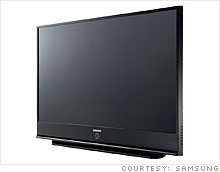 |
| Samsung's 56-inch HL56A650C1F, priced at $1,800. |
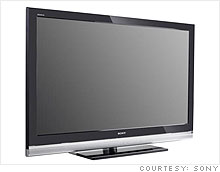 |
| In the other corner: Sony's 52-inch Bravia KDL-52W411, for $3,000. |


HOUSTON (Fortune Small Business) -- Our Houston-based film production boutique, Zenfilm, specializes in advertising, music videos, documentaries, web video, and media strategy. As a husband-and-wife director-producer team, we have been making motion pictures together for almost 20 years.
We spend a lot of time evaluating and optimizing the look and feel of film and digital media. We recently spent more than $100,000 to upgrade our headquarters with professional high-definition editing systems and monitors. So it made sense for us to review two of the latest HDTV sets available to the consumer market.
We tested two different flavors of HDTV technology. One, from Sony (SNE), represents the now commonplace LCD screen. The other set, from Samsung, is a digital light-processing (DLP) TV.
DLP TVs project their images from the back of the set, much like a traditional television. They are generally lighter and cheaper, and experience has taught us that they also produce better images than LCDs. Would that hold true in the consumer market as it does in the world of professional monitors?
To find out, we invited 11 of our colleagues from the creative community over for a movie night. We chose to watch 2001: A Space Odyssey on Blu-ray DVD - half of it on one set, the second half on the other. We also watched a standard DVD of a TV spot (featuring ZZ Top) that we'd created for the city of Houston.
We chose 2001 because it's a difficult movie for most monitors to handle. There are a tremendous variety of images to render and many extreme contrast ratios. Frankly we didn't expect any consumer monitor to get it all right. In both cases, we were pleasantly surprised.
The SAMSUNG HL56A650C1F ($1,799) performed very well, considering its modest price point. In many scenes we were amazed by the depth of the color information and the superior quality of the saturation. One panel member said he was "transfixed" by the clarity.
The primary drawback, however, was the detail on black parts of the image. When viewed with factory settings, the screen had too much contrast. When the contrast was adjusted, the black lost some of its richness. (Filmmakers like their blacks very black and their whites very white; if the blacks are a little gray, we get cranky.) We tried the stereo speakers on the set but found the sound quality pretty thin. Viewers who care about sound should also invest in separate high-end speakers.
The Samsung's menu and operating system were easy to use, very accessible, and well designed. But some of us found the blue light on the front of the set annoying.
While many on our team liked the Samsung, the SONY BRAVIA KDL-52W411 ($3,000) blew us all away. Its high-contrast-ratio image was so transparent that at times it felt as if we could walk into the film. Many of our guests who had seen 2001 before commented that it was like watching Kubrick's masterpiece for the very first time. That was surprising, considering our recent history of DLP and LCD comparisons. But this Sony LCD is special.
We watched the monitor using factory settings. Our picky crew felt no need whatsoever to tweak the image. The Bravia's audio reproduction was also better than the Samsung's, although the internal audio still didn't do justice to the film. The Bravia's menu navigation and operation were very well designed and easy to use.
BOTTOM LINE: Some of our panel could have gone either way. We think the late Stanley Kubrick and the very much alive ZZ Top would have been pleased with their presence on both sets. The Samsung is a solid choice for viewers who can't afford the Bravia.
But the Sony Bravia is Zenfilm's No. 1 choice for picture reproduction, sound reproduction, and operational functionality. We think it worth the extra $1,000 and will probably install one in our conference room for client screenings.
Any company that needs to make high-quality video presentations will want to consider both monitors. They are capable of showing HD video at its true native rate of 24 frames per second, as well as TV at its regular 29.97 frames per second - so you get the best of both worlds. TVs of this price were half the size and half as capable just two years ago. As two people who work with $20,000 professional broadcast HDTV monitors on a daily basis, we can say that the gap between professional and consumer worlds is narrowing fast.
Last, we were very pleased with our four-year-old HDTV at home, until we checked out these sets. This assignment is going to cost us big dollars, but it will be money well spent. 
A $9,000 bargain TV
Hollywood finds depth: 3-D boom
Saving the cineplex: Can an entrepreneur persuade movie houses to go digital before it is too late?

-
 The Cheesecake Factory created smaller portions to survive the downturn. Play
 -
 A breeder of award-winning marijuana seeds is following the money and heading to the U.S. More
 -
 Most small businesses die within five years, but Amish businesses have a survival rate north of 90%. More
 -
 The 10 most popular franchise brands over the past decade -- and their failure rates. More
 -
 These firms are the last left in America making iconic products now in their twilight. More









 My dream is to launch my own business someday. Now that it's time to choose a major, I'm debating if I should major in entrepreneurial studies or major in engineering to acquire a set of skills first. Is majoring in entrepreneurship a good choice? More

 When it comes to in-flight pampering, the amenity kits offered by these 10 airlines are the ultimate in luxury More
 From a text therapy platform to apps that push you reminders to breathe, these self-care startups offer help on a daily basis or in times of need. More
 From Uber's flying cars to the Hyperloop, these are some of the neatest transportation concepts in the works today. More
 More Small Business


