
Fed lending program not yet taking hold
Central bank is buying corporate debt, but other investors have been resistant to lend in a still nervous market.



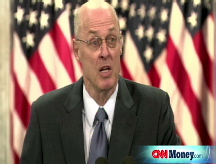
NEW YORK (CNNMoney.com) -- Despite a nearly $150 billion Federal Reserve effort to boost the critical business lending market, early indications show the central bank's program has not yet encouraged investors to buy up corporate debt.
The Fed last week started buying corporate debt that matures in three months through its so-called Commercial Paper Funding Facility.
The aim: boost liquidity in the dried-up market.
But according to Fed data released Wednesday, total commercial paper issued Tuesday with maturities of more than 80 days stood at just $9.6 billion. That's significantly lower than the $19.9 billion on Monday and last week's daily average of $52.7 billion.
Commercial paper is short-term debt that big businesses and financial institutions sell primarily to money market fund managers and other institutional investors. The companies use the loans to fund day-to-day business operations.
Dozens of companies have made use of the program, selling billions of dollars of paper to the Fed over the past week-and-a-half. But the central bank placed limits on what each company can sell to the Fed, and as those limits were reached the market apparently contracted again - as it did after the credit crisis erupted in mid-September.
The Fed will release a weekly measure of the overall commercial paper market on Thursday. Still, the drastically lower issuance numbers compared to the prior week suggest that the Fed remains the only major buyer for three-month paper.
"The Fed's program was not a magic solution," said Andrew Brenner, senior vice president of MF Global. "People are still nervous about buying, especially those who are worried about where they're going to stand at the end of the year."
The fourth quarter is the most critical period for lending, as financial institutions are hesitant to lend with the risk of taking a hit to their balance sheets at the end of the fiscal year.
One possible reason why the Fed's program has not yet encouraged other lenders is that the Fed offers much lower borrowing rates than the rest of the market. The Fed offered rates as low as 1.55% for three-month paper Wednesday, but the free market's rates for similar paper stood at about 2.6%.
"Until the free market rate gets in line with the Fed's rates, people will continue to issue paper to the Fed and no one else," said Brenner. "The Fed's borrowing rates are just so low."
The Fed had hoped that is program would serve as a backstop for the market, encouraging other lenders to buy up paper as well. The program still may take hold, but the wait may be longer than the Fed had hoped for.
Did you vote for Obama? How do you think the new president will affect your wallet? What do you think Obama needs to do to fix the economy - both in the short run and the long term? What should be first on the new Congress's agenda? E-mail us your thoughts, including your name, photo and contact info; the best answers will be featured in an upcoming CNNMoney.com article. 



