
Stimulus: The stuff Obama would build
The president-elect is proposing a massive project to overhaul the nation's infrastructure, but can it keep a deep recession at bay?



 |
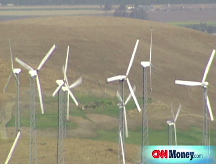
| Barack Obama is proposing a massive plan to jumpstart the economy through infrastructure investment. What might he build? |


NEW YORK (CNNMoney.com) -- America may soon get a whole lot of new stuff.
As part of a new, massive spending plan designed to jumpstart the economy, there's talk of spending hundreds of billions of dollars on new roads, bridges, trains, schools, power plants, transmission lines and energy-efficient homes.
Details on the plan are few. Numbers tossed around range anywhere from $300 billion to $700 billion, and include other measures aimed at stimulating the economy such as tax cuts and money for businesses.
On Monday, President-elect Barack Obama said the measures would be "creating and saving 2.5 million jobs - jobs rebuilding our crumbling roads and bridges, modernizing our schools, and creating the clean energy infrastructure of the twenty-first century."
While the "saving" part of Obama's jobs pledge leaves plenty of wiggle room - it's nearly impossible to say how many jobs would be lost if the stimulus isn't enacted - experts say the next president is generally on target.
"It sounds big, but this is not an unrealistic number he's throwing out there," said Jim Glassman, a senior economist at J.P. Morgan, noting that an economy not in recession generates 1.5 million to 2 million jobs a year anyway.
Although Glassman thinks the tax cut portion of the plan will generate the most jobs, plenty of others have high hopes for the infrastructure part.
On the transportation side, last year's disaster in Minnesota is a stark reminder of what needs to be done on the nation's highways.
"Repaving the roads and strengthening the bridges are very important things to do," said Martin Wachs, director of transportation, space and technology at the Rand Corp., a research outfit. "It's like addressing a backlog of needs."
The backlog is certainly there. Some 3,000 projects, estimated to cost over $18 billion and supporting over half a million jobs, could be under contract in less than 90 days, according to the American Association of State Highway Transportation Officials. The federal government would merely have to release money to the states and these things could be up and running.
Longer term, some argue that creating transportation corridors that bundle together highways, high-speed rail links, pipelines, utility lines and other infrastructure projects would prime the economic pump - not only by creating the jobs during construction, but by speeding up commerce afterwards.
"If you're going to spend money, I can't think of anything better to spend it on," said John Cogan, Houston-based head of global energy and infrastructure projects at the law firm McDermott, Will & Emery. "It would make this economy and enormous engine you couldn't stop."
This opinion is not unanimous. Ever since the Great Depression, economists have debated what makes a better stimulus during recession - government spending or tax cuts and rebates.
It's not that the country doesn't need more roads and schools. It's just that these projects take too long to get up and running to create jobs in the short term.
Moreover, they tend to last several years, so if the economy does bounce back in short order they can become inflationary - tying up money and labor.
"It's a sledgehammer, not a scalpel," said Martin Regalia, chief economist at the U.S. Chamber of Commerce, a business lobby group. "There's just one thing that works for the economy, and that's cash in the hands of consumers."
The other major part of the infrastructure plan is energy, and it's something Obama has been touting since early in his presidential campaign.
He has long called for an an alternative energy project similar to the Apollo Project that put a man on the moon. During the campaign, he pledged to spend $150 billion over 10 years on renewable energy, originally paid for by a tax on carbon dioxide. Al Gore has called for far more - $400 billion over 10 years on the electricity grid alone.
Although the Obama team couldn't be reached for comment, it now seems his energy plan may become a central part of a stimulus package. It may be run out of existing agencies such as the Department of Energy, or it could fall under a new "climate and energy tsar" that Obama is reportedly considering.
To generate the jobs quickly - Obama's 2.5 million pledge is supposed to happen in two years - experts say the government will need to focus on energy efficiency.
This includes things like wrapping water heaters in insulation, caulking or replacing windows, and switching to more efficient appliances.
"There's an army of unemployed construction people, and it could be done quickly," said George Sterzinger, head of the Renewable Energy Policy Project, an advocacy group.
Long term, Sterzinger said the government needs to establish both stable tax credit policies for people who buy renewable power, as well as provide incentives to encourage domestic manufacturers to retool and employ Americans making cutting edge solar, wind and other renewable energy products.
America, he said, used to lead in designing and building renewable energy systems, but has since lost that manufacturing edge - not to countries with cheap labor costs such as China, but to places such as Germany and Denmark where the government supports these industries.
"There is such a focus on projects that you miss the discussion on the best way to develop the industry," he said. "We can still get back in that game."
Transmission lines also need improving. While some argue that entire new lines need to be built, it's possible to create jobs and efficiency simply by upgrading what's already there, said Edward Guinness, co-manager of the Guinness Atkinson Alternative Energy Fund.
Installing wires capable of carrying more power and alleviating bottlenecks in several areas of the country are things that can be done now, said Guinness.
'It's a bit like road building, and it's quite labor intensive," he said.
Analysts were reluctant to say how many jobs a massive government push into alternative energy might yield, but did say renewables could go a long way in meeting Obama's 2.5 million goal.
"The amount of capital that would be deployed could create those jobs," said Bruce Kahn, a senior analyst Deutsche Bank's climate change research division. 'It can happen within two years. It is a short-term thing." 



