
Why investors don't care about Madoff
You'd think an alleged $50 billion scam would be the final straw for the already fragile psyche of investors. But the market has largely shrugged off the scandal.



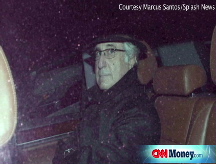
NEW YORK (CNNMoney.com) -- Multi-billion-dollar Ponzi schemes don't happen every day. Yet, investors have mostly shrugged off the allegations that Wall Street powerhouse Bernard Madoff ripped off clients to the tune of $50 billion.
Since Madoff was arrested last Thursday on a single charge of securities fraud, the Dow has gained 3% and the S&P 500 is up about 3.5%. The Nasdaq has surged nearly 5%
What gives? The Madoff story has dominated the financial headlines and even garnered attention from the mainstream press for the past week.
There are concerns that big banks around the world could suffer massive losses as a result of this fiasco. And that's the last thing they need after all the hits they've experienced in the wake of the credit crunch.
Several foreign banks, most notably Britain's Royal Bank of Scotland (RBS) and HSBC (HBC), Spain's Banco Santander (STD) and Japan's Nomura (NMR), have already disclosed exposure to Madoff.
Some commentators have even blustered about how this scandal would destroy what little faith was left in the stock market after this terrible bear of a year. This was the next Enron! Investors would have no reason to trust Wall Street ever again!
But that hasn't happened. Granted, it's only been a week since Madoff's arrest, and we may find out more details about the alleged Ponzi scheme that could wind up causing more market volatility.
Still, it is encouraging that investors seem to have tuned out the cacophony surrounding Madoff.
"When this story first broke, I was worried that this would be a touchstone for a complete erosion in confidence in the markets. I've been remarkably surprised that the market has responded reasonably well to this revelation," said Jack Ablin, chief investment officer with Harris Private Bank in Chicago.
It makes sense, though. Even if big U.S. banks start to emerge as investors whose money Madoff made off with before getting arrested, it's hard to imagine how this scandal could cause much more damage to a market that's already dealt with several crippling blows in the past few months.
"If this happened in August, it would have had more of an impact," said John Norris, an economist and managing director with Oakworth Capital, a private bank based in Birmingham, Ala. "If you were going to sell because of a negative piece of news, you probably already have taken most of your money out of the market."
In addition, there are more pressing concerns to focus on, such as the fate of the bailout for General Motors (GM, Fortune 500) and Chrysler and questions about how much longer this painful recession will last.
"Right now, the economy is front and center. Even jittery investors are looking past the Madoff debacle and focusing on the bigger picture," Ablin said.
Nonetheless, Norris said that while the Madoff mess might not cause more 700-point drops in the Dow, it may hold people back from investing in stocks any time soon.
"My bigger concern is that this keeps a lot of people on the sidelines and less willing to put money back into the markets. This may be another reason to put your money in a Folger's coffee can," he said.
But another market expert said that the Madoff brouhaha is not an indictment of the stock market but another example of lax regulation by the Securities and Exchange Commission over the past few years.
"This is not a reason to lose confidence in the markets. This is a reason to lose confidence in the SEC. The notion that markets can self-regulate and don't need cops is a faulty premise," said Barry Ritholtz, CEO and director of equity research at research firm Fusion IQ and author of the soon-to-be-published book "Bailout Nation."
So why has this story gotten so much attention if it's not something that's really likely to affect the daily lives of you and me? Well, that's obvious, now isn't it?
With names like Steven Spielberg, New Jersey Senator Frank Lautenberg and New York Mets owner Fred Wilpon among the list of possible victims of the alleged scam, the Madoff mess is a compelling general-interest story even for people who don't know the difference between a stock and a bond.
And since many of us now dread looking at our 401(k)s after this bear of a year, this is the equivalent of those cheesy "Celebrities: They're Just like Us!" photos in Us magazine of Hollywood stars doing things like taking out the garbage or going to Starbucks. "Rich People: They Make Stupid Investing Decisions Just like Us!"
Of course, the losses resulting from the Madoff imbroglio are terrible news for the investors who placed their money with him. It's particularly disheartening for the many charities that now face financial hardship because of this.
Still, the scandal is a painful reminder to all that you have to do your homework when making any investment and cannot blindly trust a financial advisor, no matter how smart, savvy or charismatic he or she may seem.
"I feel terrible for people that lost money," Ritholtz said. "But nobody asked to see audited returns, ever?" 



