
Retailers want their bailout, too
The National Retail Federation pushes for any new stimulus legislation to also include three tax-free shopping periods in 2009.



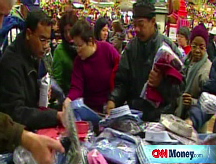
NEW YORK (CNNMoney.com) -- Facing a disastrous holiday shopping season, the retail industry on Tuesday urged President-elect Barack Obama to incorporate three national tax-free shopping holidays in 2009.
The group wants the measure to be included in Obama's stimulus efforts.
"The situation is critical," the National Retail Federation (NRF) wrote in a letter to Obama. "In October, consumer confidence was at its lowest level in the 41 years. We urge you to act quickly on legislation to help stimulate consumer spending as one of the first priorities of your new administration," the NRF said.
So far, most of the ideas under consideration as part of the stimulus package vary widely, but do not include a plan for a tax holiday.
Consumer spending is vital since it fuels two-thirds of U.S. economic activity.
To that end, the NRF proposes that tax holidays be held during March, July and October 2009, each lasting 10 days.
It said the tax-free benefits would apply to all goods subject to a state sales tax from clothing and home furnishings to restaurant dining and automobiles but would exclude tobacco and alcohol.
According to the Census Bureau, state sales tax rates range from 2.9% to 7.25%. By temporarily lifting the sales tax for the three 10-day periods, the NRF estimates that consumers could save nearly $20 billion.
Based on the 112.4 million households in the United States, the figure would amount to almost $175 saved by the average family, the group said. It says that the sales tax holidays would also help millions of U.S. retail workers keep their jobs.
The NRF wants states to opt into these tax-free holidays and is asking Obama to urge them to participate in the effort, explained Rachelle Bernstein, vice president and tax counsel with the NRF.
The group wants the federal government to reimburse states that charge a sales tax for the lost revenue from this effort. The NRF also wants states without a sales tax to get federal funds on par with the rest of the nation.
This year holiday sales are expected to be the weakest in six years, according to the NRF. That's a huge problem for merchants since the November-December shopping months can account for as much as 50% of their annual profits and sales.
Unless stimulus to aid consumers is explored, the NRF warned that the retail recession will extend well into 2009.
"It does not appear that these concerns will abate any time soon," the NRF said in the letter. "With consumer spending accounting for 70 percent of GDP, it is difficult to foresee an improvement in overall economic growth until consumers regain their footing."
Mike Englund, chief economist with Action Economics, said there are both pros and cons to tax-free shopping events.
"Typically we see spending [in stores] drop off a month before the event as people hold off on their purchases," he said. This, in turn, "robs" spending from the surrounding months. "So the benefit to retailers may not be as much as expected."
"From a policy standpoint, perhaps the most effective way to deal with the sales tax issue is to lower the tax rate rather than eliminate it altogether," he said, adding that a lower rate rate would be an incentive to consumers to shop more while states would still get the revenue to invest in infrastructure development.
All news is bad news in real estate right now. Have you recently bought a house anyway? Send your story and photos to realstories@cnnmoney.com and you could be featured in an upcoming article. 



