
Thousands of stores to disappear in '09
Experts say disastrous holiday sales will force many more merchants into bankruptcy - and ultimately into liquidation.



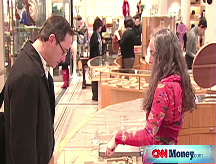
NEW YORK (CNNMoney.com) -- The ugly sales year that was 2008 will haunt U.S. retailers in 2009, with industry experts warning that disastrous holiday sales will spark a domino effect of store closures and bankruptcy filings.
And, with thousands of fewer stores, the "shop-'til-you-drop" mentality that has characterized American consumerism could be coming to an end.
"There's going to be a massive sea change in the retail landscape," said Nina Kampler, executive vice president with Hilco Real Estate, which advises retailers on their property management.
She said many strip shopping centers already have multiple big-box vacancies after several large stores filed for bankruptcy in 2008. Some eventually went out of business.
When that happens, the smaller stores in the strip centers can't attract the requisite customer traffic to stay productive and profitable.
Michael Burden, principal with industry adviser Excess Space Retail Services, expects as many as 14,000 stores will close in 2009. "We could see among the highest ever number of closures," he said.
He said states such as Nevada, California and Florida will be especially hard hit.
The International Council of Shopping Centers estimates that chain store closings could exceed 3,100 in just the first half of the year.
Burden's firm, whose 450 U.S. retail clients include Wal-Mart (WMT, Fortune 500), Home Depot (HD, Fortune 500), J.C. Penney (JCP, Fortune 500) and Sears (SHLD, Fortune 500), helps retailers in the disposition of their surplus real estate.
He said most merchants will be in a "bunker" mentality.
"It's about survivability," he said. "Retailers have to really fight to live another day and do what they can to get through to 2010."
Burden said that means closing underperforming stores, shedding stores under bankruptcy restructuring, and even "right-sizing" stores - shrinking the store size or moving to a smaller location.
"We'll see a lot of shaking out of the industry," he said, adding that no sector will be spared. "Apparel, home furnishings, home improvement, electronics, luxury sellers will all close stores."
For consumers, it will mean both fewer stores to shop and possibly less brand variety on shelves.
"Retailers across the board from top-end luxury to mom-and-pop stores on Main Street are feeling a gigantic consumer [spending] choke from people's perceived and actual loss of wealth," said Kampler.
"At the end of the day, people are buying far less stuff. They are buying what they need as opposed to what they want," she said.
This spending slump, which started in early 2008, has already claimed a number of retail casualties. Prominent national chains such as Linens 'n Things, Steve & Barry's, KB Toys, Whitehall Jewelers and Shoe Pavilion have gone out of business.
Still others such as No. 2 electronics seller Circuit City are barely surviving, hoping to find a lifeline while in bankruptcy protection.
But after suffering one of the worst year-end shopping seasons in decades - November and December combined can account for half of merchants' annual profits and sales - experts predict that many more chains will disappear.
Kampler said she personally knows of "dozens" of retailers who are taking a very hard look at their entire business. She declined to identify them due to confidentiality agreements.
"They are considering closing entire divisions or restructuring parts of their business that they want to keep," she said
As retailers' sales continue to tumble and mall traffic evaporates, one of the biggest challenges for sellers is their rent occupancy costs.
Kampler explained that the amount of rent a retailer can comfortably pay for a given store location is proportionately related to the volume of sales generated at that location.
Ideally, she said a retailer's occupancy cost should be equal to 10% of its sales. But a long stretch of slumping sales and rising mall vacancies can dramatically push up the occupancy costs.
"Once rent and occupancy costs hit the 20% to 25% of sales threshold, you are treading water," she said. "You can't run a viable business with those numbers".
Also, once a retailer faces a cash shortage, the likely next step is to file for bankruptcy protection. To that end, Kampler predicts that retail bankruptcy filings will " be huge" in January.
But given the implosive impact of the overall economy on the retail sector, Kampler said filing for bankruptcy could be the death knell for those merchants.
"It used to be that when [a company] filed for bankruptcy, it was to restructure its debt and realign its operations in order to emerge alive," she said.
"Now it's almost impossible to restructure," she said, pointing out that a significant number of retailers that did file for Chapter 11 bankruptcy protection this year have eventually gone into liquidation.
Burden agreed with Kampler.
"Companies in bankruptcy aren't getting debtor-in-possession financing," he said. "This will continue in 2009."
Burden said his firm historically advised retailers to always re-evaluate the bottom 10% to 15% of their store base, or the poorest-performing stores in their portfolio, for closures.
But given the level of anxiety in the industry about a severe spending freeze, he said many retailers are already looking at closing up to 25% to 30% of their store base.
"Obviously fewer stores means less choice for consumers," he said.
"I think the whole consumer economy is being recalibrated," said Kampler. "It's something that's not been done in decades. I think it will be a three-year recalibration of consumer behavior and expectations."
While it's something that she believes is "unavoidable" and will hit the economy in terms of more job losses, she hopes it will also change the consumers' buy-at-all-cost shopping mentality.
"Consumers are used to thinking about buying 50 T-shirts, 10 pairs of jeans and 6 sneakers," she said. "Do we really need all this stuff? Ultimately we will all be buying less." 



