CNNMoney.com
Companies Economy International Corrections Pre-market Trading After-hours Trading Winners/Losers/Actives Bonds Currencies Commodities World Markets Money Magazine Real Estate Taxes Jobs Ask the Expert Money 101 Autos Mutual Funds The Help Desk Loan Center Best Places to Live Ask the Expert Ultimate Guide to Retirement Retirement Calculators Best Funds Ask the Mole Best Places to Retire Big Tech Blog Techland Blog Sectors and Stocks Fortune 500 Techs Tech Talk 100 Best Places to Launch Ultimate Resource Guide Small Biz Makeovers FSB 100 Ask & Answer Fortune 500 Technology Investing Management C-Suite Rankings Main Create Portfolio Edit Portfolio Create Alerts Edit Alerts
SPECIAL REPORT

Treasury invests $15B more in banks

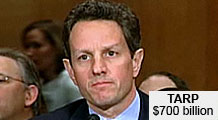
Another round of capital investments under the $700 billion bailout brings the total amount dispersed to $187.5 billion. Citigroup also gets its emergency $20B.

EMAIL  |   PRINT  |   SHARE  |   RSS
 
google my aol my msn my yahoo! netvibes
Paste this link into your favorite RSS desktop reader
See all CNNMoney.com RSS FEEDS (close)
By David Goldman, CNNMoney.com staff writer

How will the Obama stimulus proposal affect the economy?
  • It will end the recession quickly
  • It won't end the recession, but will soften its impact
  • It will make the recession worse
  • No impact
Tracking the bailout
Who's getting the bank bailout money
The government is engaged in an unprecedented - and expensive - effort to rescue the economy. Here are all the elements of the bailouts.

NEW YORK (CNNMoney.com) -- The Treasury Department said Monday it had invested $15 billion in another seven banks, including two companies that recently completed takeovers of other banks.

Under the $700 billion Troubled Asset Relief Program, Treasury has allocated $250 billion for capital investments in banks.

Treasury lends funds to banks in exchange for preferred shares, warrants, and high-paying dividends. The aim: to encourage strapped-for-cash financial institutions to lend more money and provide much-needed liquidity in the financial markets.

As of Monday, the government has injected $187.5 billion into 215 banks.

In the latest round, PNC Financial Services Group, Inc. (PNC, Fortune 500) got the most with a $7.6 billion investment - the eighth-largest such investment to date. PNC recently acquired struggling Cleveland lender National City Corp. In fact, Treasury gave PNC preliminary approval for TARP on the same day that the bank announced it would be purchasing National City for $5.6 billion.

Treasury also gave $3.4 billion to Fifth Third Bancorp (FITB, Fortune 500). On Nov. 1, Fifth Third acquired failed Freedom Bank from the Federal Deposit Insurance Corp. to the tune of $36 million.

The most recent round of capital investments from the Treasury highlights the biggest complaint that many economists and lawmakers have about the bailout - that banks aren't necessarily using the money for lending. Many banks appear to be either hoarding the cash from TARP or using it for other purposes, such as acquiring weaker banks.

Some members of Congress and oversight officials have said the plan lacks the ability to determine whether the money lent to banks is being used for its intended purpose.

Others object to the largest banks receiving the largest sums of money. For instance, Wells Fargo (WFC, Fortune 500), JPMorgan Chase (JPM, Fortune 500) and Citigroup (C, Fortune 500) all received $25 billion.

Citigroup got another $20 billion from Treasury Monday, bringing its total to $45 billion. The extra loan was part of a massive rescue package for Citigroup in late November on fears that the bank would cause a systemic failure if it should collapse.

Also on Monday, Treasury sent $2.3 billion to CIT Group (CIT, Fortune 500), $1.4 billion to SunTrust Banks (STI, Fortune 500) and $412 million more to three smaller local banks.

The capital investment plan has received the largest portion of the $700 billion bailout money so far. But it was not part of Treasury's initial strategy, which included buying up droves of toxic mortgage-backed securities. The Treasury soon abandoned its initial bid, saying capital injections served as the best method of restoring the financial markets to normalcy. To top of page

Features
America's Best Places to Live
Yes, strong local economies still exist. These small towns have 'em - plus great schools, affordable homes, low crime, and more. See Money's top 100 – including detailed city profiles, homes for sale, and job openings. More
Markets Last Change
Dow Jones 8,146.52 -36.65 / -0.45%
Nasdaq 1,756.03 3.48 / 0.20%
S&P 500 879.13 -3.55 / -0.40%
10-year Bond 98 13/32 Yield: 3.31%
U.S.Dollar 1 euro = $1.395 0.001
July 10, 2009 4:03 PM ET
CompanyPrice% Change
General Motors Corp 1.16 37.99%
American Intl Group Inc 11.80 24.47%
CIT Group Inc 1.55 -16.66%
YRC Worldwide Inc 1.31 -12.08%
Jul 10 3:56pm ET †
More Galleries
Best home deals in the Best Places Sellers everywhere have had to shave asking prices to attract buyers -- even in Money's Best Places to Live. Here are homes with some of the biggest price cuts in the top 10 cities. More
Best places for the rich and single Seeking a sugar daddy (or sugar-mama)? Follow the money to these towns and cities, where affluent young professionals are abundant. More
Where homes are affordable Residents who live in these 25 growing towns see their incomes go the furthest. More

© 2009 Cable News Network. A Time Warner Company. All Rights Reserved. Terms under which this service is provided to you. Privacy Policy
Copyright © 2009 BigCharts.com Inc. All rights reserved. Please see our Terms of Use.
MarketWatch, the MarketWatch logo, and BigCharts are registered trademarks of MarketWatch, Inc.
Intraday data provided by Interactive Data Real-Time Services and subject to the Terms of Use.
Intraday data is at least 20-minutes delayed. All times are ET.
Historical, current end-of-day data, and splits data provided by Interactive Data Pricing and Reference Data.
Fundamental data provided by Morningstar, Inc..
SEC Filings data provided by Edgar Online Inc..
Earnings data provided by FactSet CallStreet, LLC.