
New law could wipe out handcrafted toy makers
A new regulation taking effect next month that's intended to guarantee children protection from lead exposure may put some indie toy makers out of business.



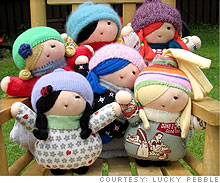 |
| Denise Mollison's Lucky Pebble dolls are a hit with online shoppers, but she's worried that the looming CPSIA law will cripple small toy businesses like hers with high compliance costs. |


(CNNMoney.com) -- When she's not busy taking care of her three kids, stay-at-home mom Denise Mollison spends her time stitching together cherubic rag dolls, which she then sells online at her shop, The Lucky Pebble, and at Etsy, an online marketplace. Her plump creations have garnered extensive praise from fans of handmade goods, and Mollison's Etsy page is filled with rave reviews from happy customers. But a new law passed to ensure the safety of toys and children's clothes may unintentionally cripple small businesses like hers.
After a spate of toy recalls made headlines in 2007, Congress passed the Consumer Product Safety Improvement Act in July 2008. The law, which goes into effect on February 10, sets strict limits on lead and phthalate (a harmful chemical found in plastics) content in toys and other children's products. Toymakers must certify their wares' compliance via third-party testing, which can cost anywhere from less than a hundred dollars to several hundred dollars per test - and each component of a toy, such as zippers, buttons, and paint, must be tested separately. Retailers must also ensure that their entire inventory is certified. Toymakers and retailers who violate the law face fines of tens of thousands of dollars.
The law makes no distinction between large-scale manufacturers, mom-and-pop businesses, and one-man operations. While large corporations may be able to easily absorb the costs of product testing, the price is potentially overwhelming for small businesses.
The Consumer Product Safety Commission - which cannot change the law, only enforce it - is scrambling to clarify certain vague language of the law, and to establish clearer rules for testing. On Tuesday, January 6, the commission voted on certain provisions that may offer relief to some toymakers. However, a second vote - which will not take place until after the law goes into effect - is needed to finalize the rulings.
"We don't want to fly under the radar for safety, we just want a cost-effective way to comply," Mollison says.
Mollison sells her dolls for around $30 to $50 each, earning about $8,000 in 2008. The money she makes supplements her husband's income and helps pay the medical expenses for daughter Raven, who has special needs and requires a feeding device.
"The safety standards are perfectly reasonable, but the testing costs are not sustainable for a micro-business," says Dan Marshall, founder of the Handmade Toy Alliance. Marshall and his wife, Millie Adelsheim, own a St. Paul, Minn., store called Peapods, which specializes in natural, no-frills toys such as wooden blocks and trains, as well as other baby products and clothes.
"There's no sense of scale, no exemptions based on the size of the business," Marshall says. "It doesn't make sense for someone who's knitting kids' hats in their living room to pay hundreds of dollars to test each hat." Members of the alliance - more than 170 retailers, toymakers, and concerned citizens - have inundated the Consumer Product Safety Commission with letters, faxes and e-mails expressing their fears and offering suggestions.
Etsy, the online marketplace for handmade goods, posts regular CPSIA news updates on its Web site to keep its users as informed as possible.
"Everyone has questions; there's a lot of speculation and rumor," says Matthew Stinchcomb, Etsy's communications director. "We're trying to educate our users, but even the CPSC doesn't really know what's going to happen on February 10."
Stinchcomb says that many Etsy users are liquidating their merchandise for fear that it will be considered contraband when the CPSIA goes into effect.
Two of the CPSC's recent rulings could help some craftspeople and retailers if they are finalized when the commission votes again at a yet-to-be-determined future date. The first would exempt certain natural materials, such as wood, wool, and cotton, from testing, as it is widely accepted that such materials do not contain lead or phthalates.
"If a baby blanket is 100% cotton, or you have a set of unfinished wooden blocks, then those items wouldn't necessarily have to be tested," says CPSC spokeswoman Julie Vallese. "There's room under the law for certain exemptions."
Another proposal would recuse toymakers from testing their raw materials if the suppliers provided certification instead. However, it's not currently a common practice for suppliers to offer such certifications. Before the CPSC's second vote, the public will be invited to comment via mail, fax, or e-mail.
The commission also recently tried to clarify the law's effect on secondhand retailers such as thrift shops and consignment boutiques, but its ruling left many resellers even more puzzled. Store owners had expressed concern that proving that the lead and phthalate content in used toys fell below the new guidelines would not be feasible without new testing. The CPSC said last week that sellers of used toys aren't required to test their inventory for compliance - but they're still responsible for ensuring that all goods they sell meet the new limits. Any store owner who sells a product that violates the limits could face civil and criminal penalties.
"Congress failed to address some things when they wrote the law," the CPSC's Vallese acknowledges. "And the CPSC is a small agency with limited resources." There will still be plenty of kinks to be worked out after February 10.
In the meantime, handmade advocates like Dan Marshall are coping as best they can by staying informed and lobbying for improvements in the law's implementation.
"Everyone's just trying to make sure they've got all their ducks in a row," Marshall says. "The ironic thing is that at my store, we've been trying for 10 years to find as many alternatives to mass-produced products as possible. A wooden toy is a way for kids to relate to the natural world; they can see what it's made of, and they can invest their own imaginations in it. It's a better toy." 
6 U.S. toy makers profit after the China recalls
In China, outsourcing is no longer cheap
Lax oversight, globalization erode product safety

-
 The Cheesecake Factory created smaller portions to survive the downturn. Play
 -
 A breeder of award-winning marijuana seeds is following the money and heading to the U.S. More
 -
 Most small businesses die within five years, but Amish businesses have a survival rate north of 90%. More
 -
 The 10 most popular franchise brands over the past decade -- and their failure rates. More
 -
 These firms are the last left in America making iconic products now in their twilight. More









 My dream is to launch my own business someday. Now that it's time to choose a major, I'm debating if I should major in entrepreneurial studies or major in engineering to acquire a set of skills first. Is majoring in entrepreneurship a good choice? More

 When it comes to in-flight pampering, the amenity kits offered by these 10 airlines are the ultimate in luxury More
 From a text therapy platform to apps that push you reminders to breathe, these self-care startups offer help on a daily basis or in times of need. More
 From Uber's flying cars to the Hyperloop, these are some of the neatest transportation concepts in the works today. More
 More Small Business


