
How to spend $700 billion in 6 months
Funds allocated to the TARP bailout are almost spoken for. Experts say Geithner will need to ask for more, but that could prove to be a difficult task.



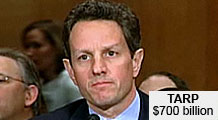
NEW YORK (CNNMoney.com) -- Remember that $700 billion financial sector rescue plan from October? It's all but spoken for.
After Treasury Secretary Tim Geithner promised to spend up to $100 billion on a toxic asset purchase plan Monday, only $35.2 billion remains unallocated in the Troubled Asset Relief Program. (See correction)
After former Treasury Secretary Hank Paulson determined how Treasury would spend up to $380 billion of the funds in his tenure, the new administration has committed another $315 billion in just two months. But with the government's rescue programs still incomplete, Geithner may need to ask for more.
(For a look at how Treasury and other government agencies have used taxpayer dollars to rescue the economy, click here.)
"Secretary Geithner is going to need to go to Congress and ask for more money sooner rather than later," said Anne Vorce, policy director at the New America Foundation, a public policy think tank. "He's done everything possible not to go back to Congress, but now the amount left is a worry."
Treasury thus far has been able to step in when systemically significant financial institutions threatened to fail, sending an additional $20 billion to Citigroup (C, Fortune 500) in November, $20 billion to Bank of America (BAC, Fortune 500) in January, $40 billion to American International Group (AIG, Fortune 500) in November and another $30 billion to AIG in early March.
But if Treasury needs to step in and send emergency funds to another bank, it will only be able to give half what it gave to AIG unless it gets more money from Congress or uses money that had been allocated to other TARP programs.
It's not that the Treasury Department has spent all the money -- it still has about $342 billion left to spend. But the Treasury has designated $307 billion of that in various programs and guarantees. For instance, it has guaranteed up to $5 billion in Citigroup loans, and allocated $100 billion to pay for losses the government expects to suffer from its new consumer lending initiative. The money isn't gone, but it's accounted for.
Still, if a large bank were to fail, Treasury would likely intercede. As President Obama explained in an interview on the CBS program "60 Minutes," a large bank failure poses a threat to drag down the financial system.
"There are certain institutions that are so big that if they fail, they bring a lot of other financial institutions down with them," Obama said the interview, which aired Sunday night. "I think that systemic risks are still out there."
The Treasury Department downplayed concerns that its planned initiatives outstrip its funds.
A Treasury official said the department has substantial resources granted by Congress and will continue to work with lawmakers to make sure they have the necessary resources in its financial sector rescue efforts. He did not say whether Geithner would ask Congress for more funding but noted that its TARP programs have been designed to maximize the value of every taxpayer dollar spent.
Despite some sentiment that the Treasury's coordinated rescue effort will help the economy and financial markets rebound sooner than if the government had taken no action, policy experts still believe that Geithner would face a difficult challenge if he asks for more money. Geithner took political hits last week when he was blamed by some for failing to react swiftly enough to the hundreds of millions of dollars of bonuses paid out by bailed out insurer AIG.
"Last week was not a good week for the administration and Tim Geithner, but this new plan seems to be well-received," said Vorce. "Still, it will be difficult for Geithner to get money for what needs to be done next."
Geithner has avoided asking for more funds during his two-month tenure. When he appeared before the Senate Budget Committee on Feb. 11, he was questioned by several committee members if the then $320 billion of funds left unallocated in the Troubled Asset Relief Program would be enough. The Treasury secretary responded that the money was sufficient for Treasury's near-term purposes, and a request for more money -- if needed -- will be done "with as much care and consultation and design as possible."
Since then, Treasury has committed another $285 billion to various programs, including $5 billion to auto parts suppliers and $30 billion more to AIG.
In addition to propping up banks and other businesses, Treasury has used TARP for several other financial rescue initiatives, including $50 billion for a foreclosure mitigation program, $20 billion for a consumer lending initiative and the $100 billion effort to rid banks of toxic assets announced on Monday.
Correction: In an earlier version of this story, we reported that Treasury allocated all but $10.2 billion. In fact, the Treasury is only spending $50 billion on the foreclosure mitigation program. The other $25 billion is coming from other government agencies. CNNMoney regrets the error. 



